
The People’s Money
What 10,000 community loans taught us about trust, debt, and who gets to protect a forest.
By Aurore Maxey
This article draws on field documentation, reflections, and case studies prepared by Planet Indonesia facilitators and community partners across West Kalimantan, including contributions from Ghufron, Kristin, Kelvin, Yamin, and the Dabong field team.
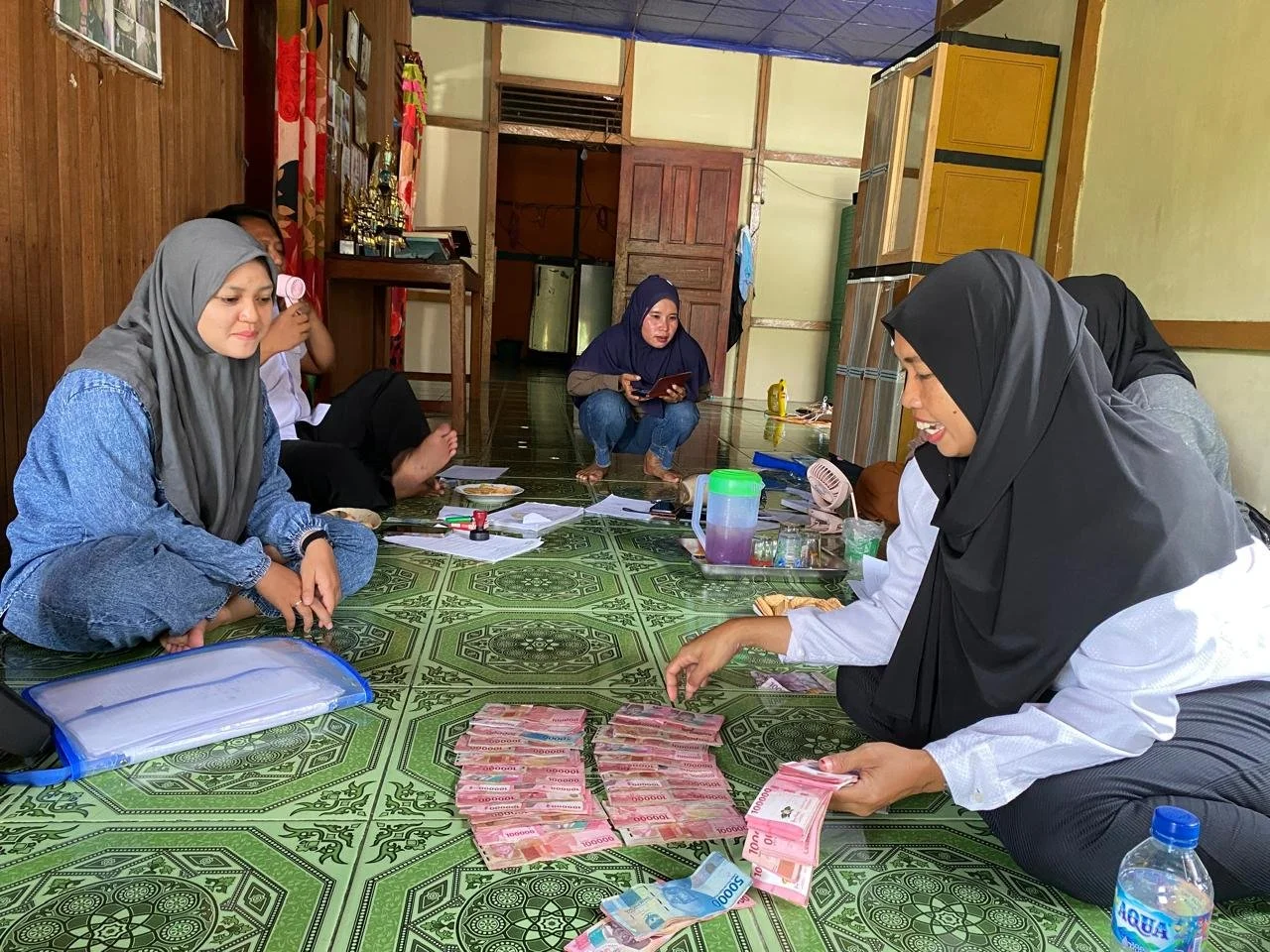
Working group members of the savings and loands group are conducing a verification of the cash on hand availabilty against their financial records.
When a community sets up a savings and loans group, it is building something new together: a shared fund, a set of rules, a small working group to run it. It asks people to trust one another, and to trust the system they have built, to believe that the money they put in will be there, fairly managed, when they need it. That trust is built over time, in the ordinary work of holding a fund together.
Savings and loans groups like these are often a community's first step toward financial inclusion: a way for people with no access to a bank to save safely, borrow fairly, and build an institution they run themselves.
For the most part, these groups work without a hitch. Money is saved, loans are repaid, local, sustainable businesses are built, and funds are managed year after year by people who have never run anything like them before. But any institution run by people can be strained in human ways, and trust, once given, can be misused. What matters is not whether that ever happens but what a community does when it does.
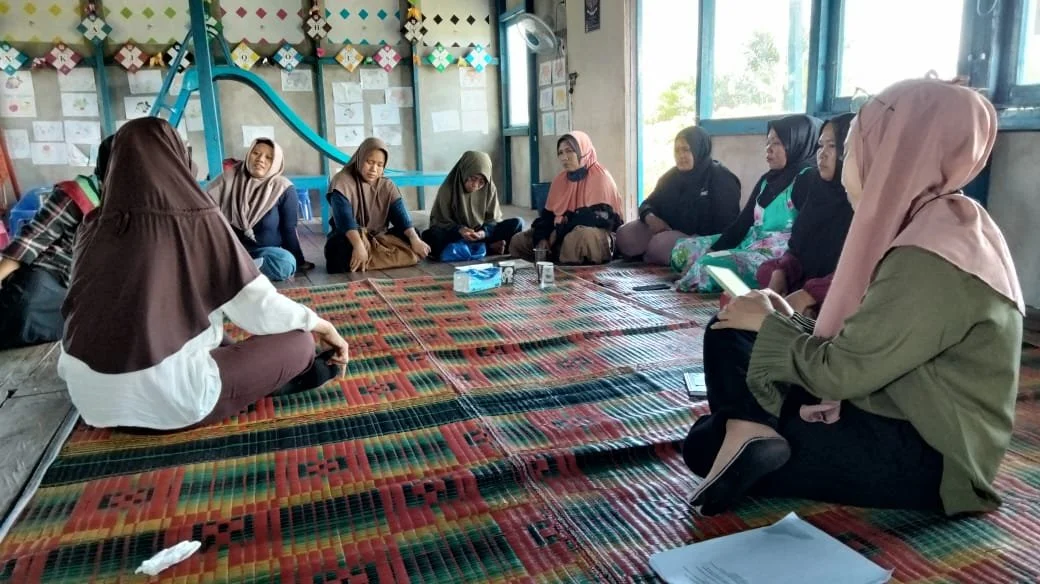
Group meet in Dabong village
In Meriam Jaya hamlet, in the village of Dabong, that question came in 2023. The community had formed its savings and loans group two years earlier, "a new hope," as the facilitator who documented it wrote, "amid economic, social, and ecological instability." But the money had begun to go missing.
A treasurer had been handing out loans outside the agreed-upon rules: to people who were not members, without records, off the books. When facilitators and the group's own leaders started checking, they found a discrepancy of around eleven million rupiah (about US$700) that no one could account for, not even the treasurer. Part of what had allowed that gap to open was a transition period in Planet Indonesia’s support. Little mentoring and frequent changes of field staff left a young group without the steady support it needed.
What followed was not a cover-up but a reckoning. Over months, facilitators and the group's own leaders worked through the records line by line, matching the treasurer's accounts against members' own savings books and going house to house to verify what each member had actually set aside. It was slow and uncomfortable. In meetings, some leaders defended one another, and others came close to walking away. Two of them, Bang Udin and Ibu Suprapti, chose to stay rather than let the group collapse.
The group’s leadership met and reached a consensus: the treasurer would be removed from the role. The decision was made internally, through deliberation within the board and through a vote. The remaining funds were handed over and placed with the chairperson for safekeeping. Bang Udin stepped forward to become the group's new treasurer, while Ibu Prapti remained in the savings and loans workgroup, helping guide its recovery. Together, the leaders rebuilt their bookkeeping from the ground up, putting together a simpler, more transparent system, with members bringing their savings books to every transaction.
The point of telling this story is not that the model failed. It is that a community held its own institution to account, and chose to repair it, and that Planet Indonesia, too, recognized what it had missed and changed how it accompanies new groups. Trust, the members understood, can be broken, but it can also be rebuilt: not through words, but through honest action and shared decisions.
This is the quiet centre of a much larger story.
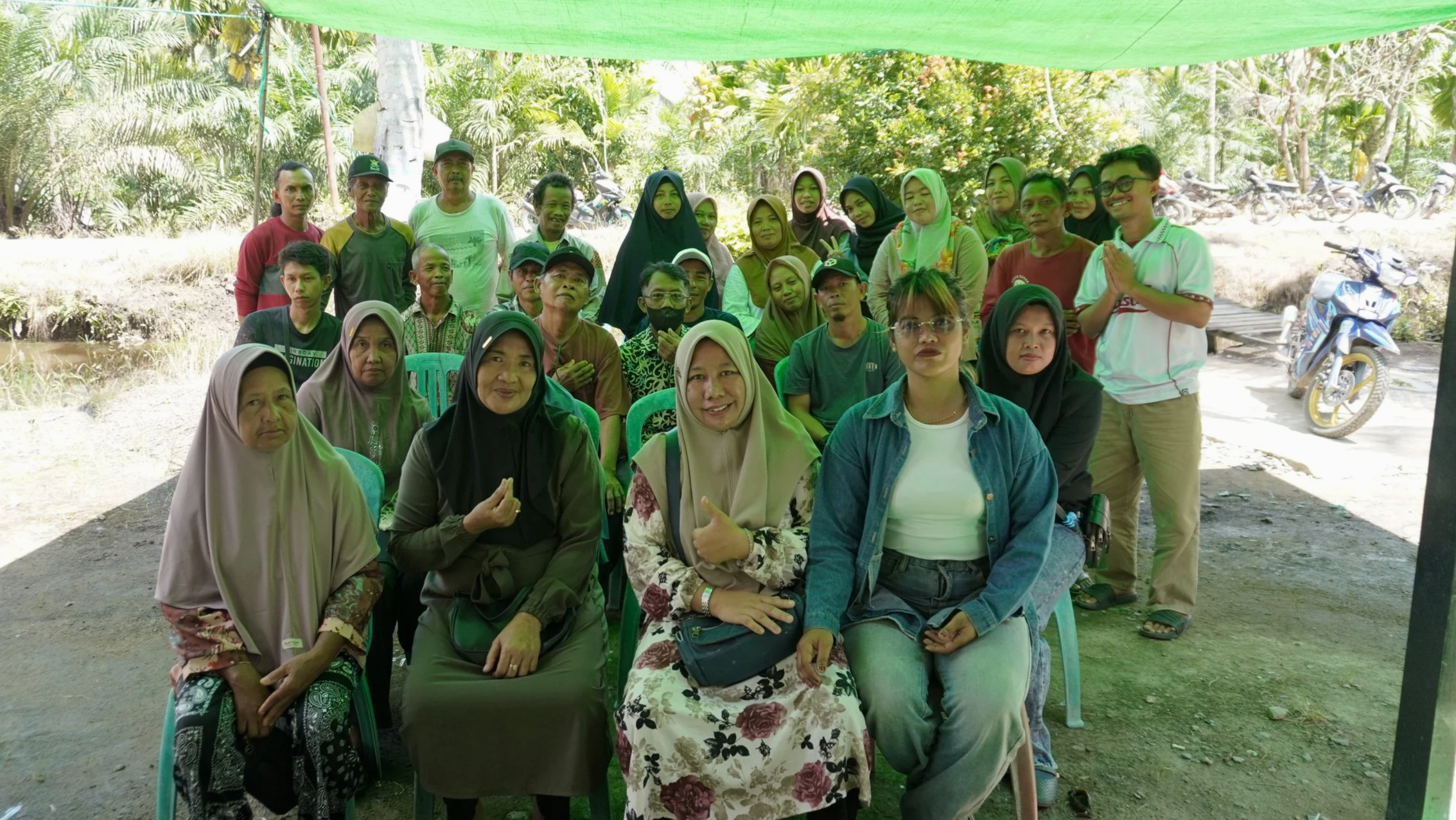
Members of the Meriam Berjaya community governance body.
Ten thousand loans
This is happening across West Kalimantan, Indonesia, in coastal mangrove villages and tropical forest communities spread over more than one million hectares. Since 2018, members of community governance bodies Planet Indonesia partners with across six districts have taken out more than 10,000 individual loans. They have borrowed for farming, for school fees, for medical emergencies, for small businesses that already existed and needed room to grow. The loans are tailored, and the interest is usually zero.
Planet Indonesia’s role begins before the first loan. As an institutional builder, we work with each community to establish and strengthen a governance body at the village level, making sure the body is formed inclusively, that its leaders are chosen by consensus, and that they are trained to keep the books and supported month after month.
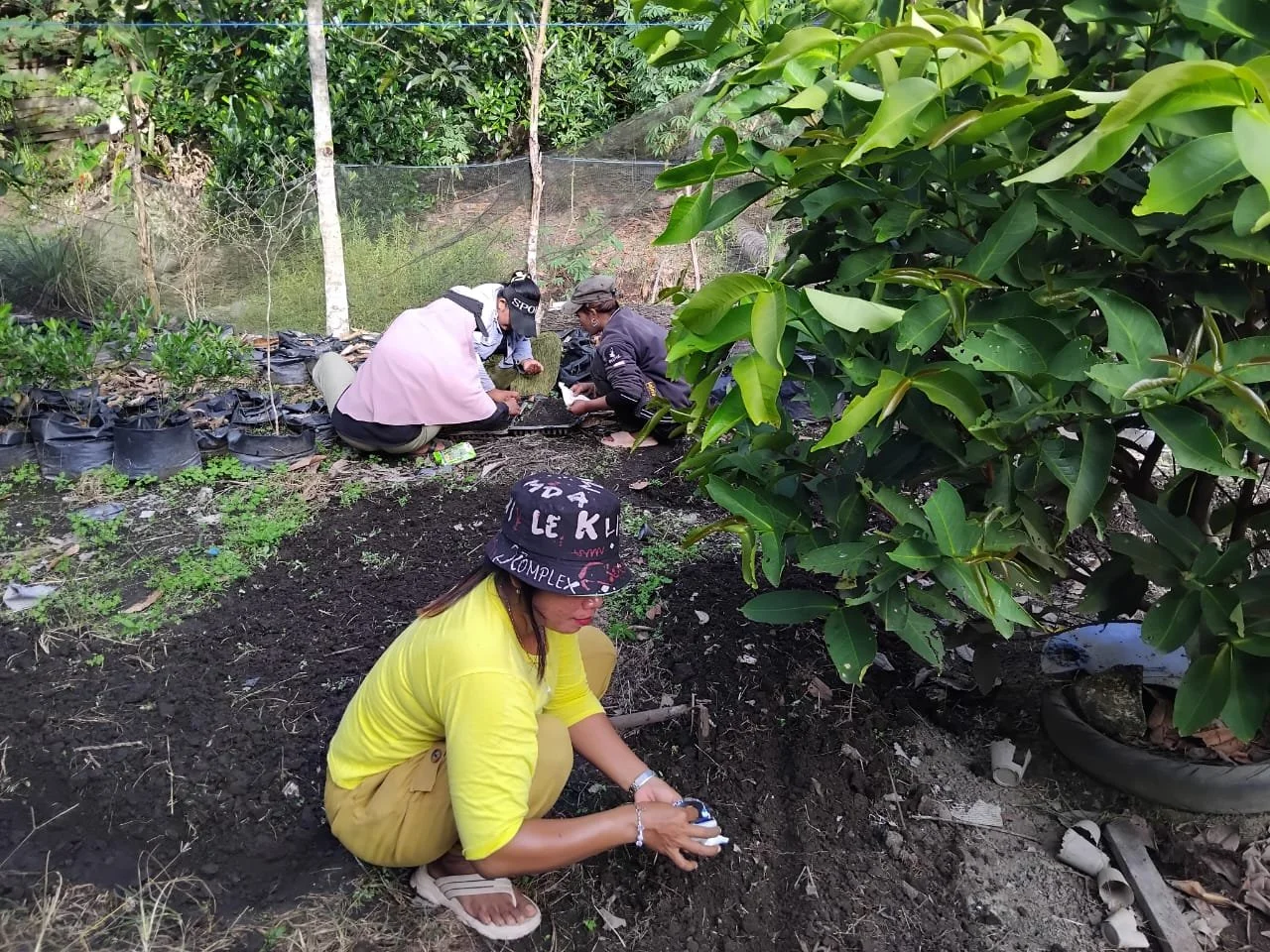
Community members tend a nursery garden
Those governance bodies are the heart of the model. Each is an elected, community-run institution that holds rights over a stretch of forest or fishery and makes the local decisions about how it is managed. The savings and loan group is one workgroup inside it, often the first thing a community builds, and it sits alongside the patrols, the mapping, and the management planning. The money, in other words, is never separate from the governance.
When communities reclaim access to money and control of it, what happens to the forests and fisheries around them?
For a long time, the sector has treated livelihoods and the environment as a trade-off. The reasoning goes that if people are poor, they will overfish, log, or clear land, so the answer is to offer an "alternative livelihood," something to do instead. Planet Indonesia’s own staff have argued that, in practice, these alternatives are hard to sustain. They are highly specific to context; they often depend on outside subsidies to survive, and they are difficult to scale. They can also miss the social reality of a place: introduce beekeeping to a community that regards beekeeping as low-status work, and few people take it up.
The communities Planet Indonesia partners with already know what earns them a living; households here typically draw on several income sources at once. The more useful question, then, is not what new activity to introduce, but what is getting in the way of the livelihoods people already have. Often, the answer is debt, and the absence of any fair place to borrow. Borrowing to cover a poor harvest or a health crisis, families can end up locked into cycles that push them toward the very extraction conservation is trying to prevent. And the answer is rarely to introduce something new; communities here are not short of ideas, but of the financial foundation to act on them.
What changes when the money is fair
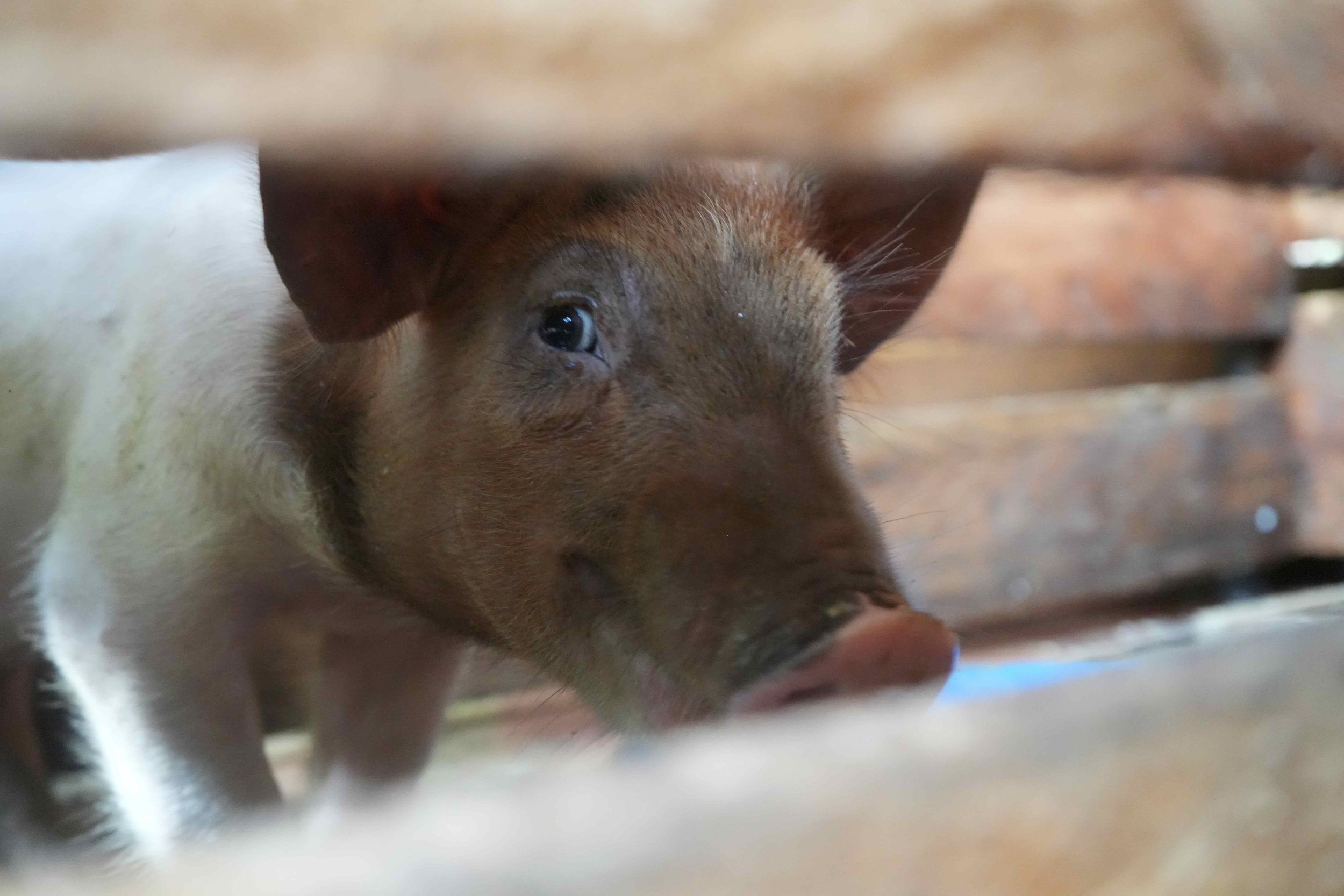
A pig farm, where community loans have helped members grow their herds.
Take Engkangin, where the day starts and ends in the pig pens. Members of the local pig-farming group are out morning and evening, feeding their animals and cleaning the enclosures, some behind their houses, some on farmland an hour and a half away on foot. A year ago, one member, Pak Itusius, borrowed from his group's governance body to build up his herd. The bet has paid off: his pigs have bred, and he now has four piglets, each growing to eight or ten kilograms. When it came time to begin repaying, he sold a single pig at the 2025 Naik Dango, the annual harvest festival of the Dayak Kanayatn, at a hundred thousand rupiah a kilogram. Other members, Bingkisno and Kristoporus, have pregnant sows of their own; most keep at least one female back, so the herd, and the income, can keep growing. No one instructed them to do that. It is simply how they have decided to run things.
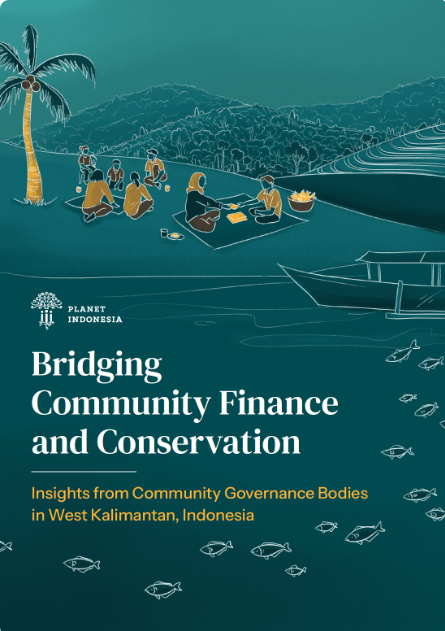
A technical report from Planet Indonesia's research team set out to test whether stories like this point to something systematic. Drawing on monthly records from community governance bodies across six districts, and a participatory impact assessment involving 38 focus group discussions with 476 participants, it traced four pathways linking financial inclusion to conservation.
The first pathway is governance. When financial pressure eases, people take part more readily in the meetings, patrols, and planning where decisions about land and water are made. In the impact assessment, 72% of focus groups mentioned financial security and improved environmental conservation outcomes together when describing what the program had changed.
The second is the debt cycle. With access to zero-interest loans, members are less dependent on lenders whose terms force short-term extraction. The economics bear out their judgment: net profit margins on group businesses averaged between 16-21% across three districts. For comparison, a net profit margin of 10% is generally considered good, and 20% is high, against a US average of about 7.6%. In one Bengkayang group, a six-million-rupiah loan (about US$380) became an estimated twenty-million-rupiah profit (about US$1,300).
Those profit figures come with an honest caveat: they describe the group loans that had been repaid. At the time of the study, a substantial share remained outstanding, and the numbers reflect the ventures that succeeded. Longer-term data from Planet Indonesia shows that 88% of loans are repaid within three years, a repayment rate that may be even higher now. Loan profitability takes time; so does the data.
But financial returns are only part of what changes.
The third pathway runs through health and education. Education was the second most common reason people gave for borrowing, after agriculture, and women borrowed for it more often than men, most often for their children's schooling. Health was a smaller share of borrowing, but it surfaced in the assessment all the same. Women leaders in Kubu Raya described how the group let them set money aside for emergencies, one recalling that it mattered most when she gave birth.
In the village of Rambai, members of the Gema Ratu group remember what borrowing used to mean: before they ran their own savings and loans, the nearest credit unions and banks were in sub-districts hours away, over dirt and broken asphalt, and a single trip could cost seventy to a hundred thousand rupiah in fuel and food before any fees. Those without that access often borrowed instead from the bos, the trader who bought their harvest: money or goods up front, repaid automatically when the crop was sold back to him, and the loan deducted from the proceeds. It carried no interest, but not everyone could use it; you had to earn the trader's trust first. In 2021, after training from Planet Indonesia, Gema Ratu's own bookkeepers began running savings and loan programs within the village. The same group now sends two of its members out on forest patrols and talks through how to protect the forest at its annual meeting. The money and the forest, here, are looked after by the same hands.
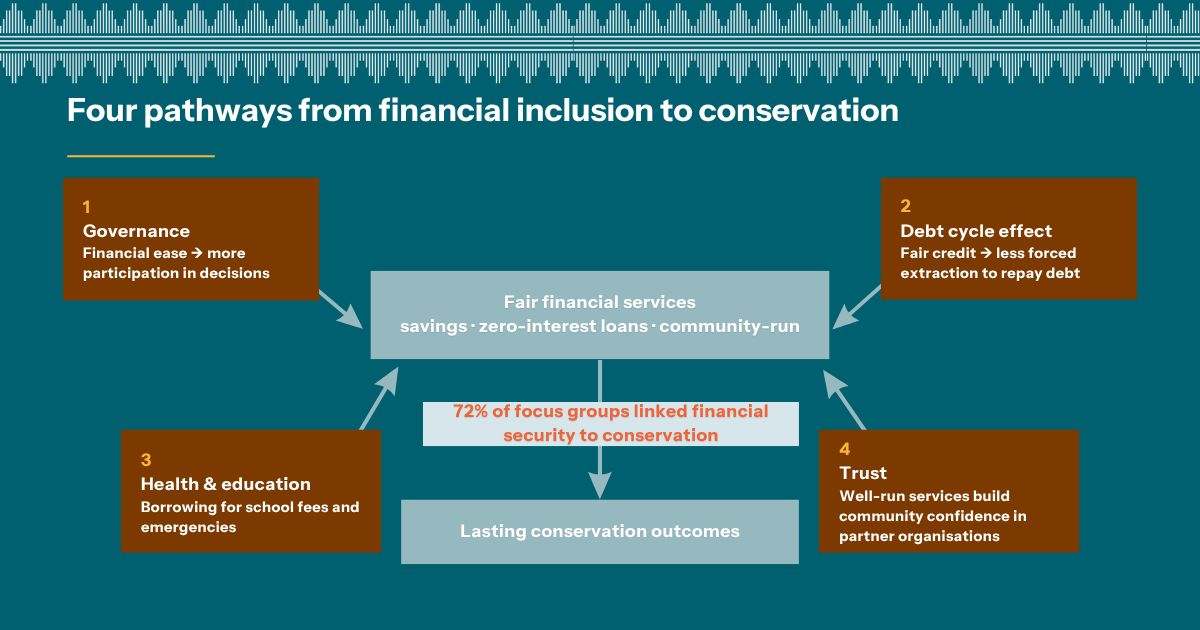
The fourth pathway is trust, what the report calls the Goodwill Effect. Conservation organizations usually arrive as outsiders, and the work stalls without the community's confidence. The report argues that fair financial services, delivered through a body the community already runs, earn that confidence: access to something useful and well-managed raises how people regard the organization working alongside them, which in turn opens the door to participation in conservation. Dabong itself is the report's example. The village first rejected Planet Indonesia's model, then, as trust grew through word of mouth from neighbouring communities, its leaders sought the partnership out. Financial services, alongside capable local leadership, were what built that acceptance.
More than money: the governance dividend
Not every group holds. In some villages, the savings activity has gone quiet: members drift away, the monthly meetings thin out, and the fund sits unused. In one community, fewer than ten members made any transaction in a recent month, and no one drew on the governance body at all; a facilitator found, held back, by the fear of not being able to pay it back. In Mengkalang, a woman who used to save with her group stopped a field facilitator on the road to ask when the savings might start again. She used to put a little aside through the year and withdraw it when the holidays came; the group has been dormant for years now, and she misses it. She wanted to know, with some hope, whether there was any chance for them to save again, whether her village's group might one day work like the ones she had heard about elsewhere.
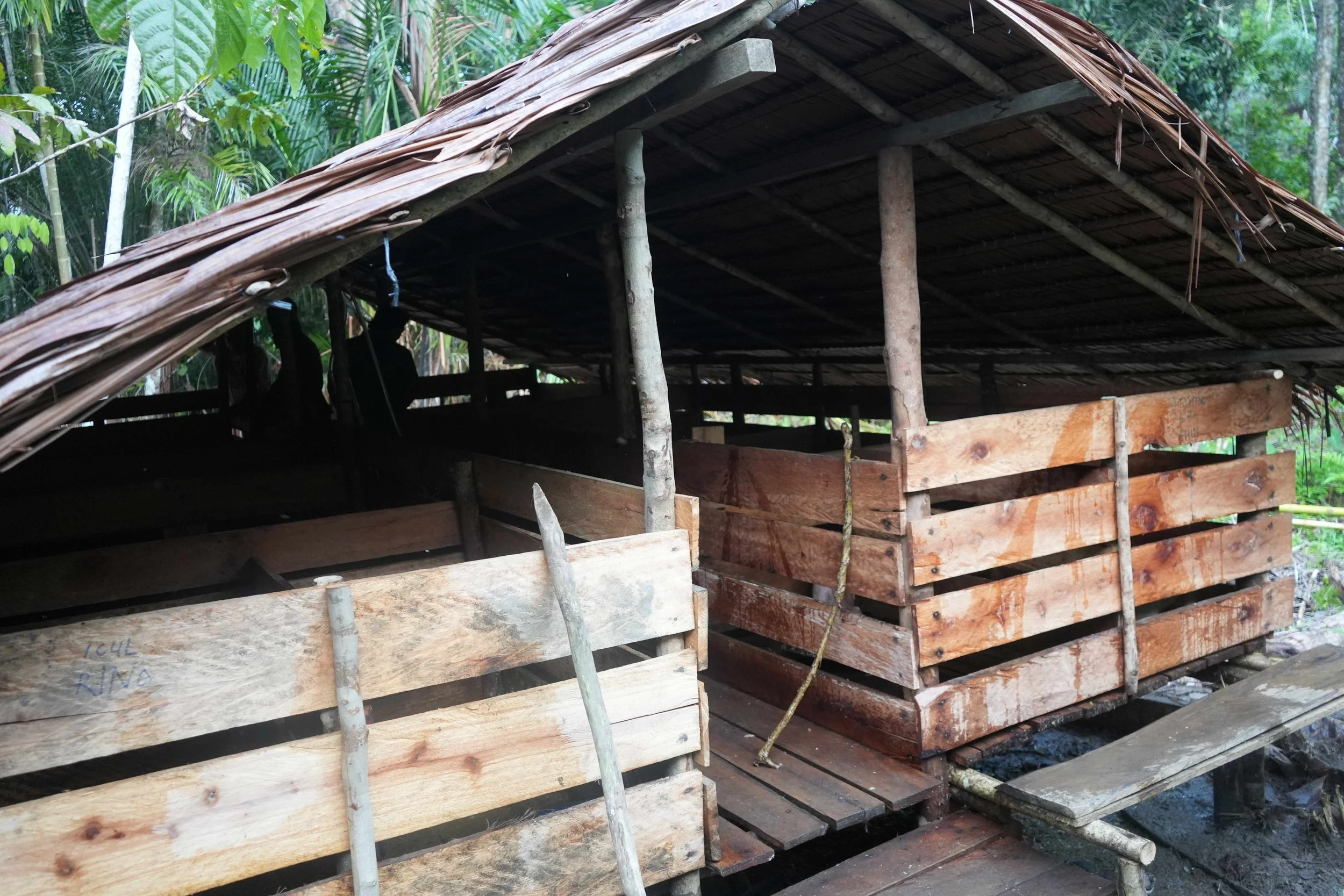
A pig pen, where livestock farming is one of the ways communities invest loan funds.
These are not failures of the people so much as reminders of how much the model asks of them: active leadership, steady bookkeeping, and enough trust to keep a shared fund moving. Where that falters, the work stalls, and rebuilding it takes time.
The loans alone are not the conservation strategy. It is when they are embedded in governance, and the community holds both, that they work for the long term. A savings group is one of the first things a community builds together, one of the first tests of whether people can set rules, hold a shared fund, and trust one another with it. When that works, and when it is repaired after it falters, communities gain both the stability and the practised habit of self-governance that lasting stewardship depends on.
What the leaders in Meriam Jaya protected was not only a fund. It was the principle that the people's money belongs to the people and is theirs to govern. That is the same principle that lets a community decide how its forest is patrolled, or its fishery collaboratively managed. The report makes an evidence-based case that fair financial services ease debt, support health and education, draw people into governance, and build trust in the organisations working alongside them.
The larger pattern underneath those pathways is the one Dabong shows plainly. None of this is fast, and none of it is tidy. It is the slow work of people learning to trust an institution they built themselves, and choosing to mend it when it strains. Planet Indonesia's role in this is narrow by design. We help communities establish these institutions, we accompany them through the hard parts, and step back as they grow, able to govern on their own. The communities of West Kalimantan are not waiting to be handed an alternative. They are building something of their own, and deciding, loan by loan and meeting by meeting, how to look after it.
If you have any questions, please reach out via admin@planetindonesia.org. Sign up for our newsletter and follow us on our social media Facebook here, Instagram here, and LinkedIn here to get timely updates on our activities, an insider’s look into the lives of front-line conservationists, and ongoing programs.