
The Country-Count Problem
The conservation sector keeps asking when we are expanding internationally.
The question confuses passport count with scale, and misreads what depth in a country like Indonesia actually does for the planet.
By Adam Miller
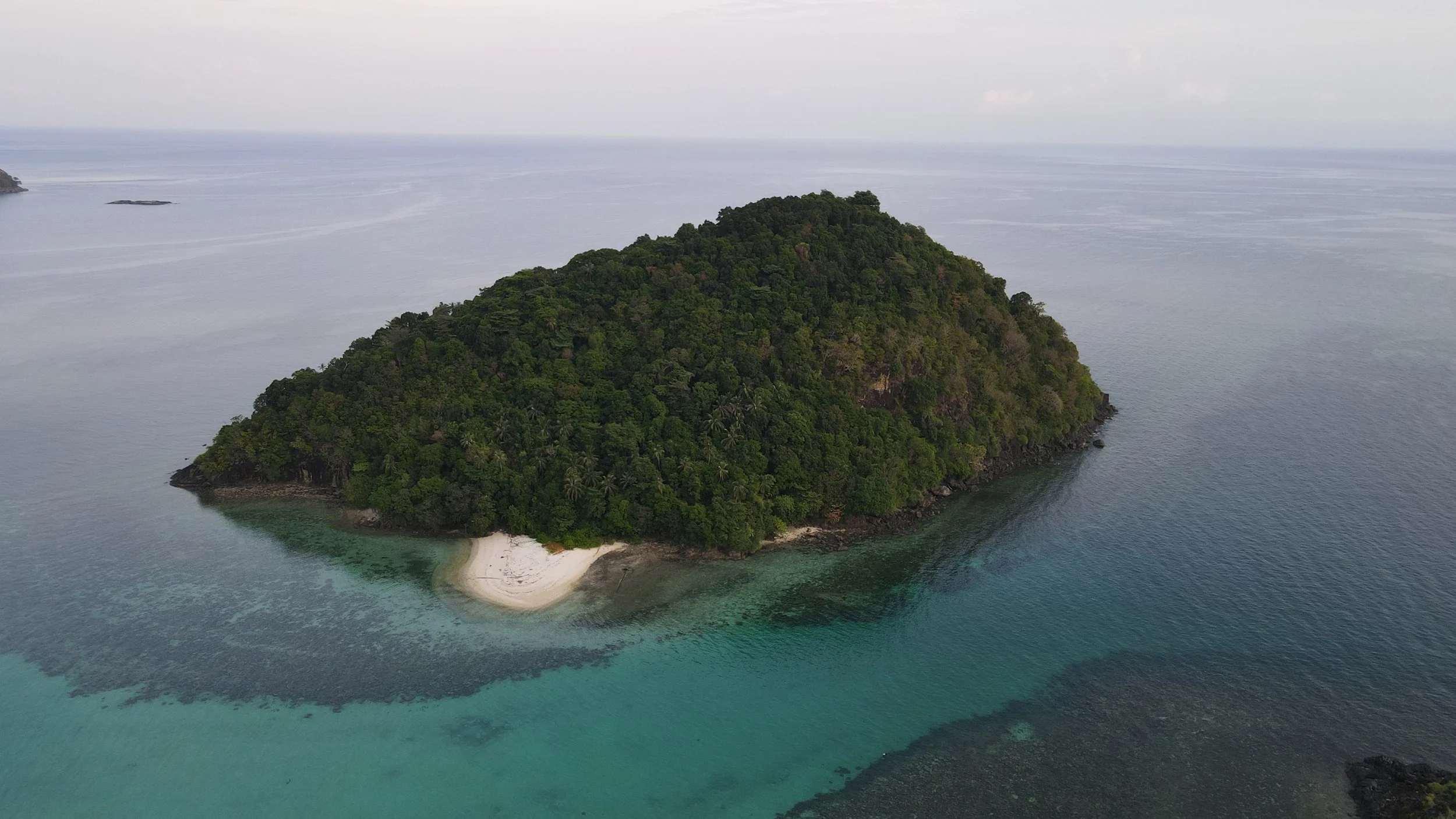
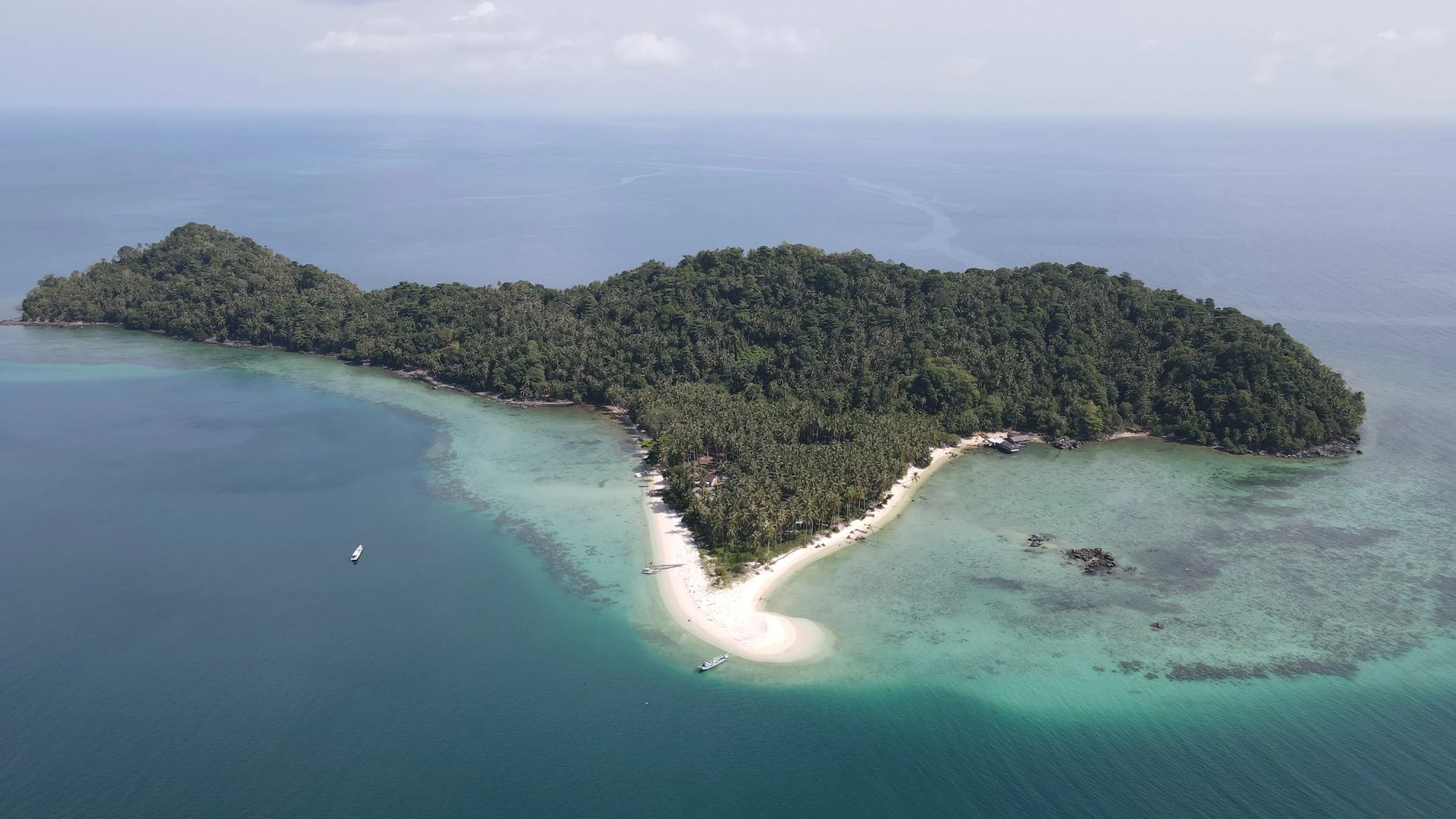
Roughly 17,500 islands. About 6,000 inhabited. Every one of them part of the same governance challenge.
The question comes up a lot. A funder lunch in New York. A Skoll World Forum meeting. A side conversation at a convening. Someone leans in and asks: “So when are you all going to move into more countries? Two? Three? Regional expansion?”
I used to try to answer it straight. Now I mostly ask a different question back.
At Planet Indonesia, we have spent more than a decade building a community‑led model in Indonesia, working alongside Community Governance Bodies on land and at sea, mobilizing grants to Indonesian partners, and pushing for the rights, governance, and policy systems that shape tropical ecosystems, across this 17,000+ island Archipelago. By most reasonable measures has moved from the early days of research and development honing our model with communities over the last 10 years, into something many would call scale: work that travels through partnerships rather than by us adding offices. Now, we enable others, as the scale jargon goes, we are shifting from a ‘doer’ to an ‘enabler.’ Scaling influence, not footprint, as we believe real scale is when others carry the work without you.
And yet the signal I keep receiving from funders, peers, and boards is that the real test of that maturity is your solution with a global passport and many stamps. That serious scaling means crossing borders. That staying in Indonesia is a prologue to the work that counts.
This piece is my pushback.
The category error
Start with the word “country.” When a scale-focused funder says “you’re in one country,” they are, quietly and often unconsciously, comparing Indonesia to Rwanda, to Costa Rica, to Malawi. The mental map flattens them into equivalent units. It should not. Three facts make this clear:
Size. Indonesia spans 5,120 km east to west, further than the continental United States or the entire European Union, across an oceanic geography of roughly 17,500 islands.
Carbon and biodiversity. Indonesia holds two of the world's twenty-five biodiversity hotspots and accounts for about one in every ten vertebrate and vascular plant species on Earth. Its peatlands alone store an estimated 28 gigatons of carbon.
Coastline. At roughly 99,000 km, the second-longest national coastline on Earth, every kilometer carries a community, a governance regime, an economy, a fishery, and a set of tenure questions.
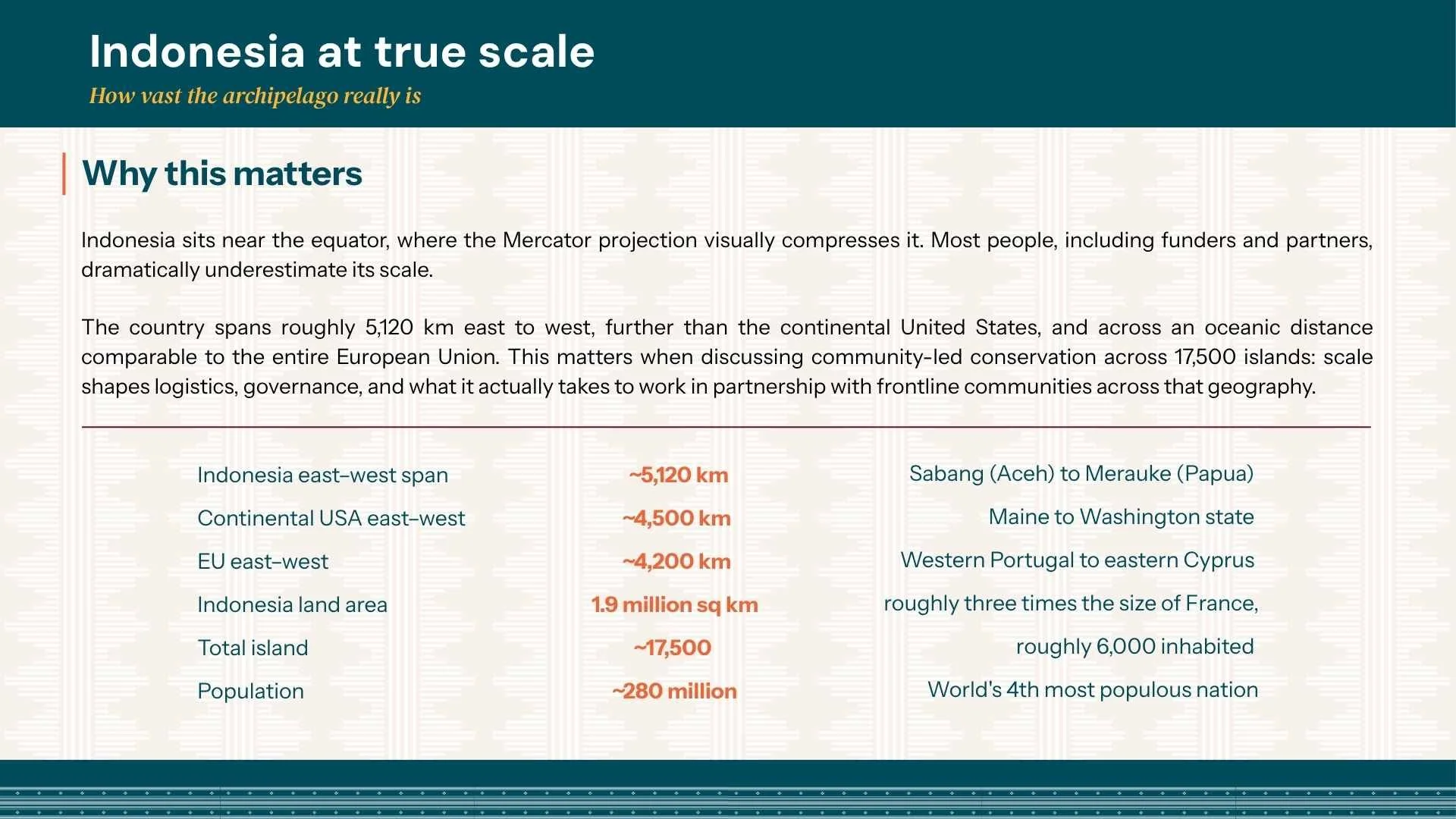
Indonesia spans roughly 5,120 kilometers east to west, from Sabang in Aceh to Merauke in Papua. That is a greater east–west distance than the continental United States (about 4,500 kilometers) (fig. 1 ) or the European Union (about 4,200 kilometers) (fig. 2), across an oceanic geography of roughly 17,500 islands, of which about 6,000 are inhabited. The land area is 1.9 million square kilometers, roughly three times the size of France. The population is around 280 million, making Indonesia the fourth‑most populous country on Earth, larger than the United Kingdom, France, Germany, and Italy combined.
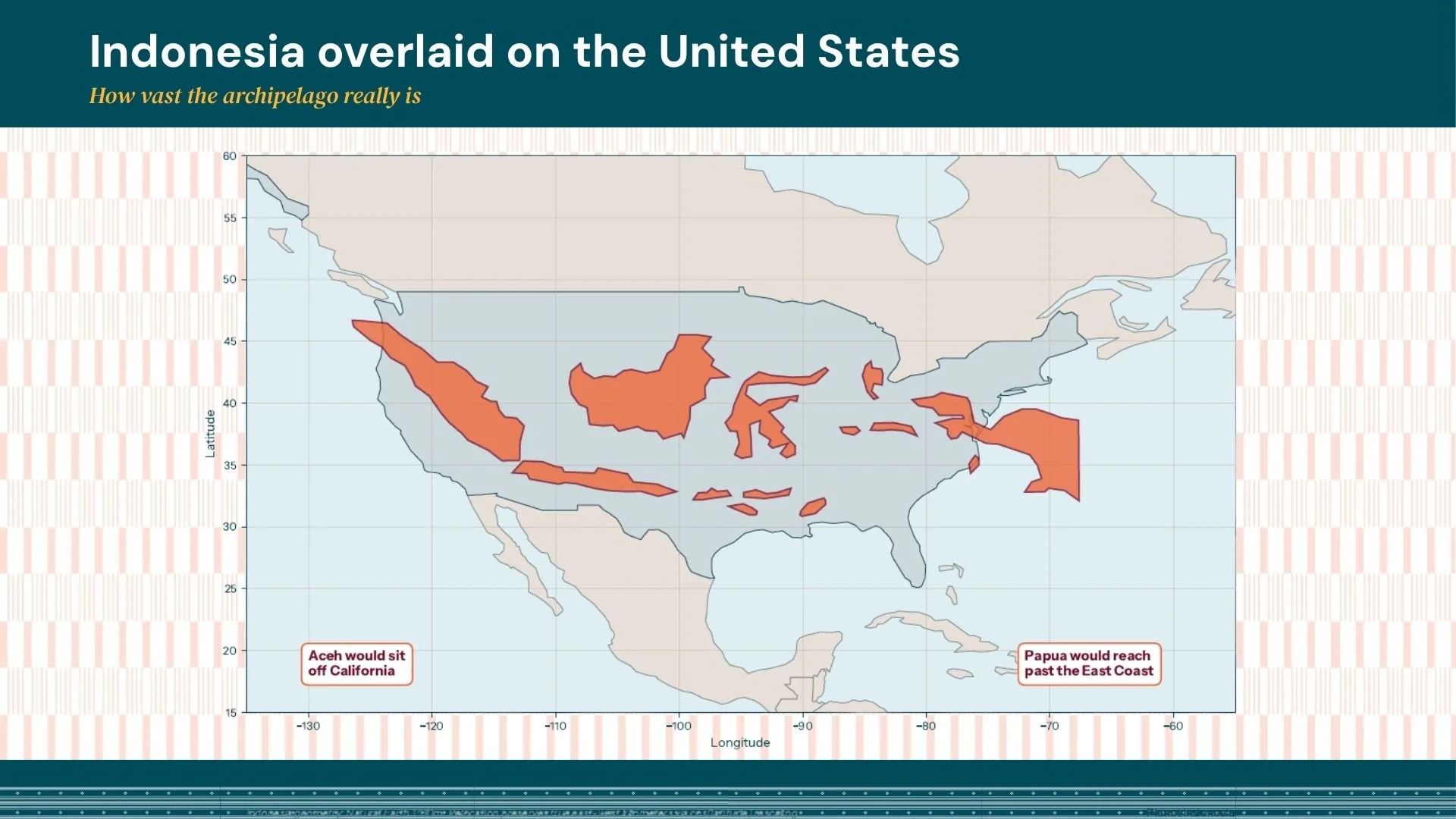
fig.1 Indonesia overlaid on the United States
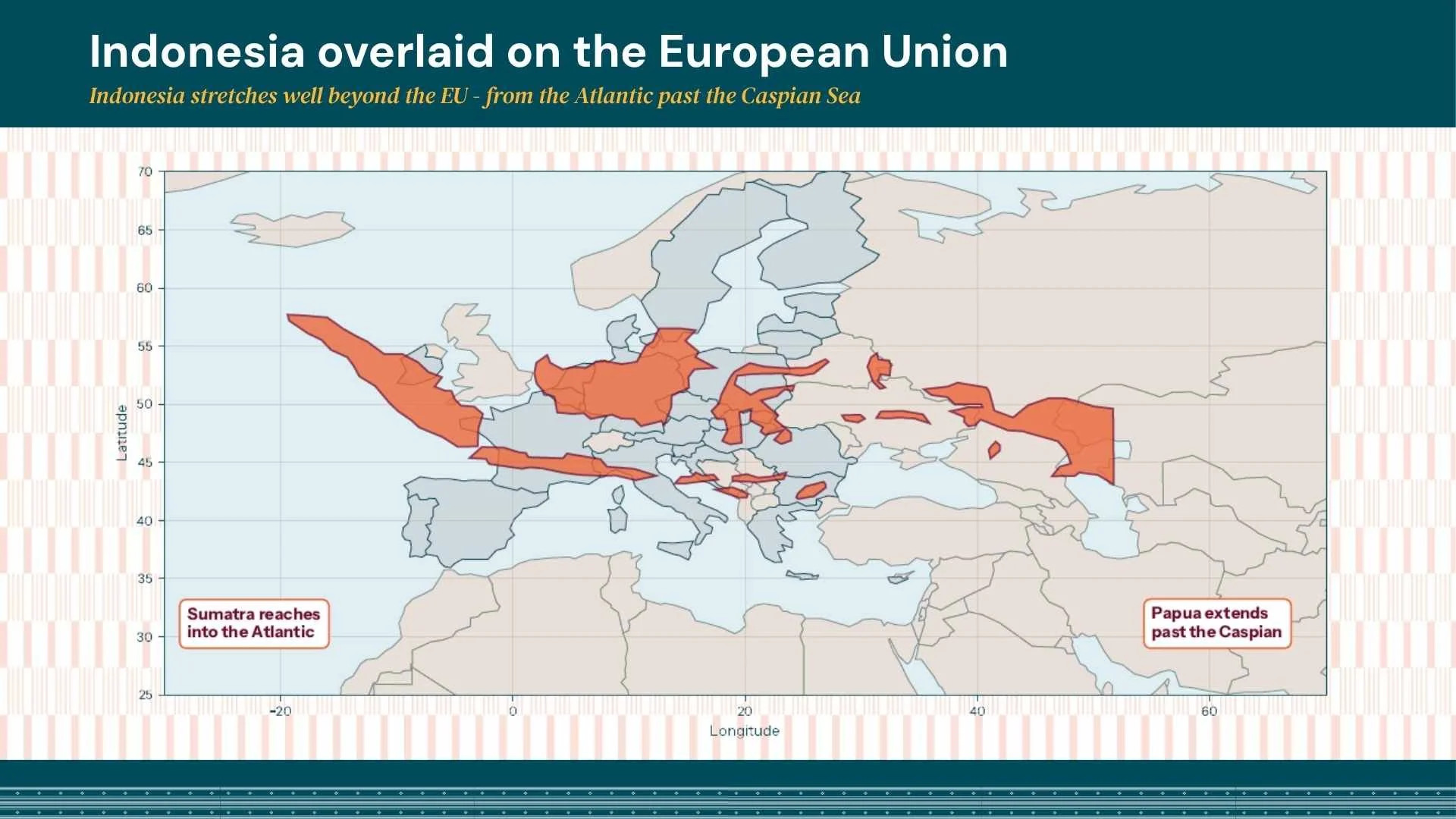
fig.2 Indonesia overlaid on the European Union
Indonesia is, in ecological and demographic terms, a subcontinent. The country holds two of the world’s twenty‑five biodiversity hotspots, roughly half of its flowering plant species are endemic, and it accounts for about one in every ten vertebrate and vascular plant species on Earth. The problem is not the ambition of organizations working here. The problem is a category error in how the sector talks about scale.
The three basins
There is a more accurate way to situate Indonesia. Climate scientists and, increasingly, climate diplomats talk about three great tropical forest basins: the Amazon, the Congo, and Southeast Asia, anchored in Indonesia. In 2022, the governments of Brazil, Indonesia, and the Democratic Republic of Congo signed a joint statement positioning themselves as a deliberate trio, collectively home to just over half of the world’s remaining tropical rainforests. Stabilizing our climate, is not possible without a serious change in three places, and one of them is Indonesia.
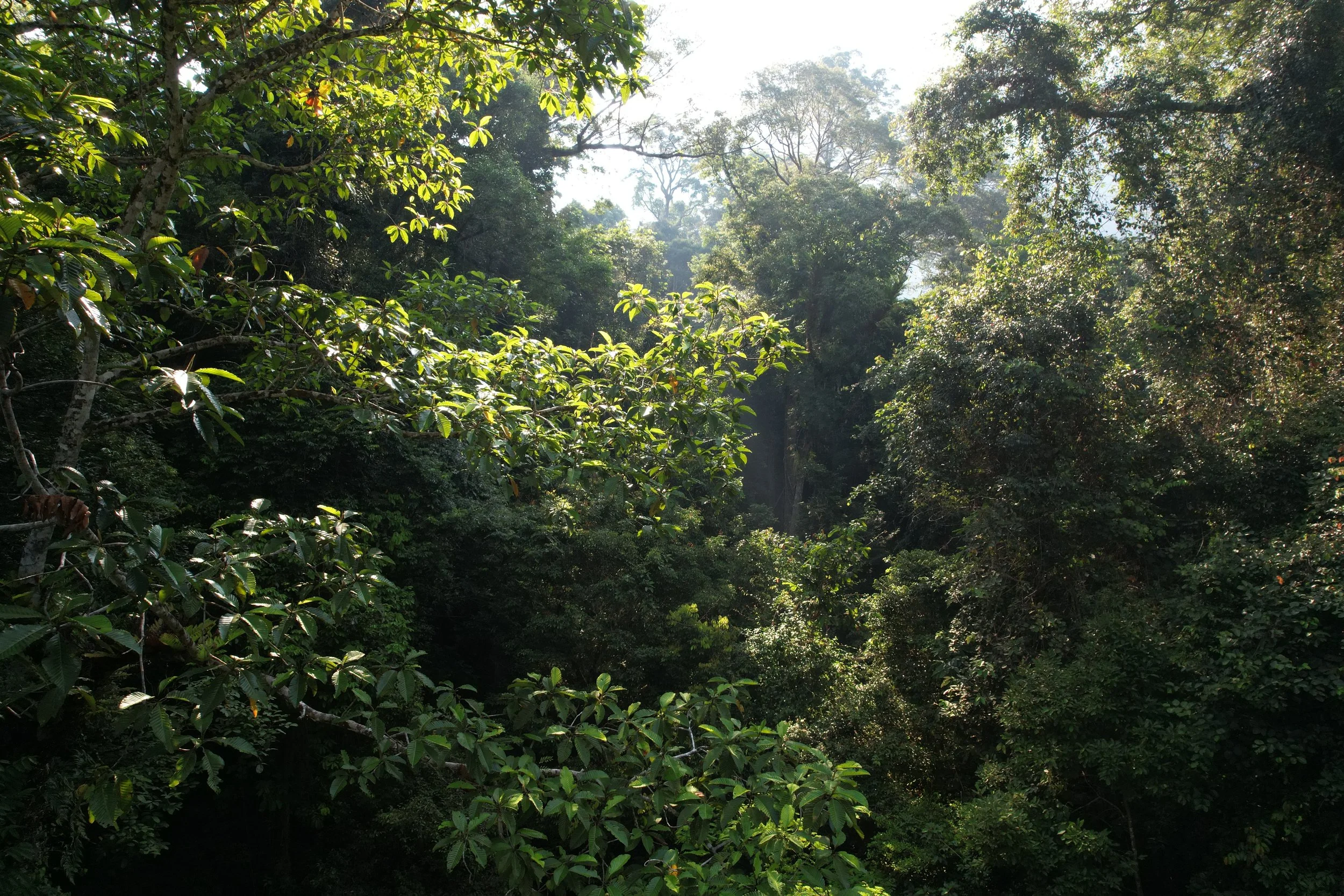
Indonesia’s peat ecosystems alone hold on the order of 28 gigatons of carbon, by current best estimates, more than the biomass of every standing forest in the country combined, and a meaningful share of all tropical peatland carbon globally. Its waters sit at the center of the Coral Triangle, the most species‑rich marine region on the planet: roughly 76 percent of the world’s known coral species in 1.6 percent of the ocean. Papua’s Bird’s Head Seascape, inside Indonesian waters, alone holds about 75 percent of the world’s scleractinian coral species.
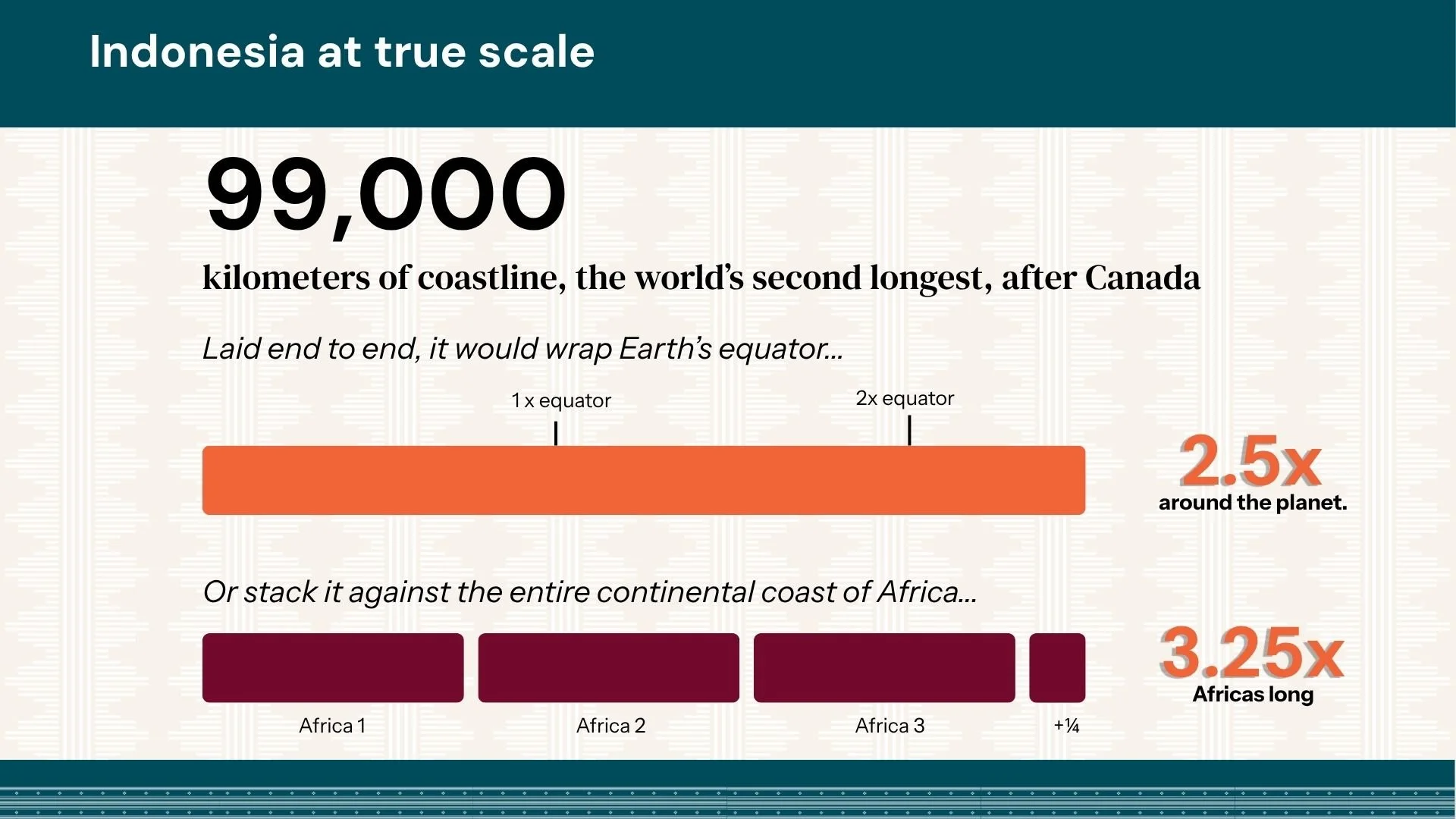
Measured along the coast, Indonesia runs roughly 99,000 km—about 2.5 times the circumference of the Earth, and 3.25 times the coastline of the entire African continent. Source: Planet Indonesia; World Atlas.
Measured along the coast, Indonesia runs about 99,000 kilometers, according to Indonesia’s National Geospatial Information Agency (Badan Informasi Geospasial, BIG)—the second‑longest national coastline in the world, after Canada. That is roughly 2.5 times the Earth’s equatorial circumference. It is 3.25 times as long as the entire continental coastline of Africa. Every one of those kilometers has a community, a governance regime, an economy, a fishery, and a set of tenure questions. Working that coastline seriously is not a country‑scale project. It is a planetary one.
One response to these numbers shows up often enough that it deserves a direct reply: “Yes, but Indonesia is mostly ocean.” It is. Indonesia’s exclusive economic zone covers about 6.2 million square kilometers, more than three times its land area, and roughly 70 percent of its national territory. Counting territorial seas and archipelagic waters on top of that, the full maritime jurisdiction is larger still. It is the largest archipelagic ocean space on Earth.
What depth actually unlocks
Consider what becomes possible when an organization stays long enough to engage Indonesia at the governance layers where conservation is actually decided.
You can work alongside hundreds of Community Governance Bodies across a bioregion and then pass the model to an Indonesian NGO network that grows it further. You can shape district‑level regulations on community forestry and customary tenure and carry that experience into national policy conversations. You can invest years in the village fund allocation process—the mechanism by which tens of billions of rupiah flow from the central government to villages each year—and shift a small share of those flows toward community governance of land and sea. You can build a regranting program that sends flexible, multi‑year funding to Indonesian organizations that the international system usually cannot see.
Some receipts. Fourteen years in, this is what depth has produced. Planet Indonesia works across roughly 1.8 million hectares with 110 communities, 55 working directly with our teams in West Kalimantan and 55 through 11 Indonesian NGO partners spanning 7 major islands and 9 provinces.
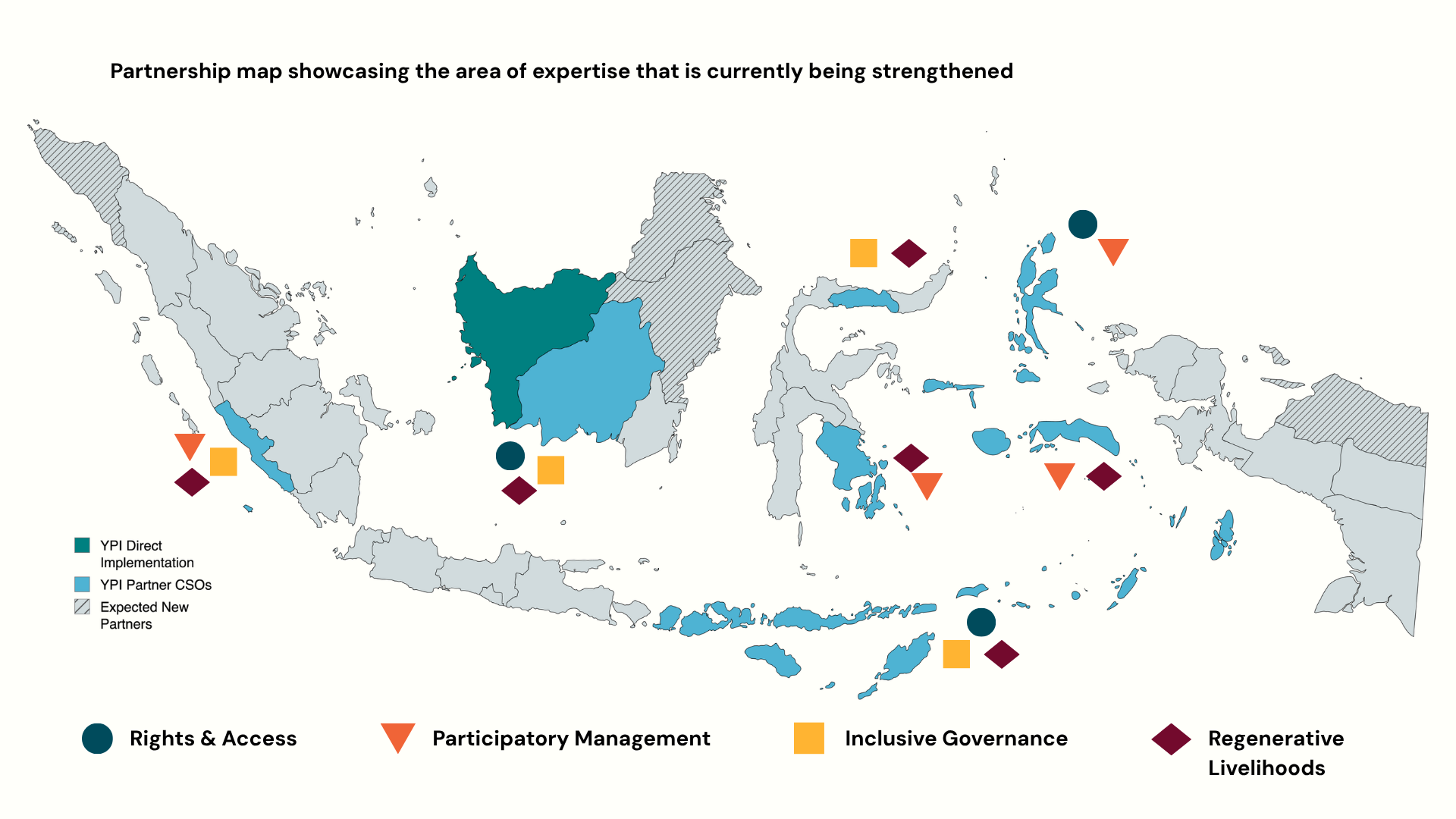
Planet Indonesia's direct operations in West Kalimantan and 11 Indonesian NGO partner organizations across 7 major islands and 9 provinces.
At our direct sites, where we have three years of before-and-after-control-impact data, we have documented 60 to 80 percent reductions in illegal logging, poaching, and deforestation inside community-managed areas. The earliest data from partner-led sites is directional rather than rigorous, but the pattern is consistent: a 63 percent reduction in forest loss at a Sulawesi partner site, and 44 and 61 percent reductions at two Sumatran sites. These are organizations that took the framework, adapted it to their own landscapes, and produced comparable outcomes with their own teams. That is the test of whether a model travels.
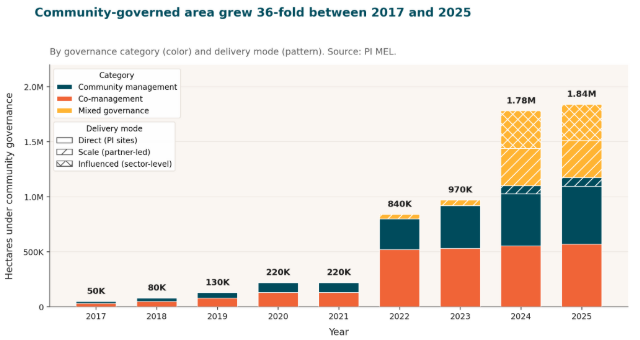
Impact durability is high: of 120+ communities, only two have exited, and all NGO partnerships since 2019 remain active, with 83% partner satisfaction. Unit economics reflect this efficiency, with conservation costs dropping from $30 per hectare in 2016 to $2.20 in 2025 as partners lead.
Our regranting architecture supports this by providing over USD 1.2 million to nine Indonesian partners over 2022-2025, growing support 65% year on year. This relational over transactional approach addresses a critical gap identified by the research conducted by Menjadi & Saraswati, where 75% of local CSOs reported limited core funding and 57% cited poor overhead support from intermediaries. As one partner noted, funding often dries up before reaching local hands; our depth ensures resources actually flow to the frontline.
This is what depth has been buying: a model that travels—measurably—and a flow of resources to organizations the international system usually cannot see.
Naming the funder dynamic
I want to say this plainly, because getting it right matters for the field.
When a funder asks us when we are going to expand, they are often not asking the organization to be more useful. They are, whether they know it or not, asking us to look more like their existing portfolio. The theory of change baked into “multi‑country” is typically a donor‑side theory: it makes comparisons easier, reads as risk diversification, and fits internal expectations about what a “scale” grantee should look like. Those are not bad instincts, but they are not the same thing as asking whether the work is becoming more influential.
There is one version of the country‑count question that deserves a direct answer rather than a deflection: the portfolio‑risk argument. Single‑country concentration carries political risk, despite the highest ROI on impact.
Political risks, such as policy reversals or NGO restrictions, are mitigated at Planet Indonesia through structural depth rather than geographic spread. Eleven independent Indonesian partner CSOs operate across nine provinces, and our regranting architecture ensures resources are distributed, not concentrated. Communities with legal tenure and diversified livelihoods are the ultimate hedge against instability. This diversification by depth is as rigorous as any multi-country strategy.
Rewarding expansion over institutional depth selects against depth and overlooks the influence, in a subcontinent like Indonesia, that contributes to global missions. The country-count question is simply easier, not better, than the influence question.
“Enough” is not “done”
To be clear, “enough” is not the same as “done.” Staying in Indonesia is not a plateau. We are still moving into new landscapes across the country, still onboarding Indonesian partners through our regranting work, still pushing for rights, governance, and financial inclusion reforms we have not cracked. The ambition is vast, and so is the challenge.
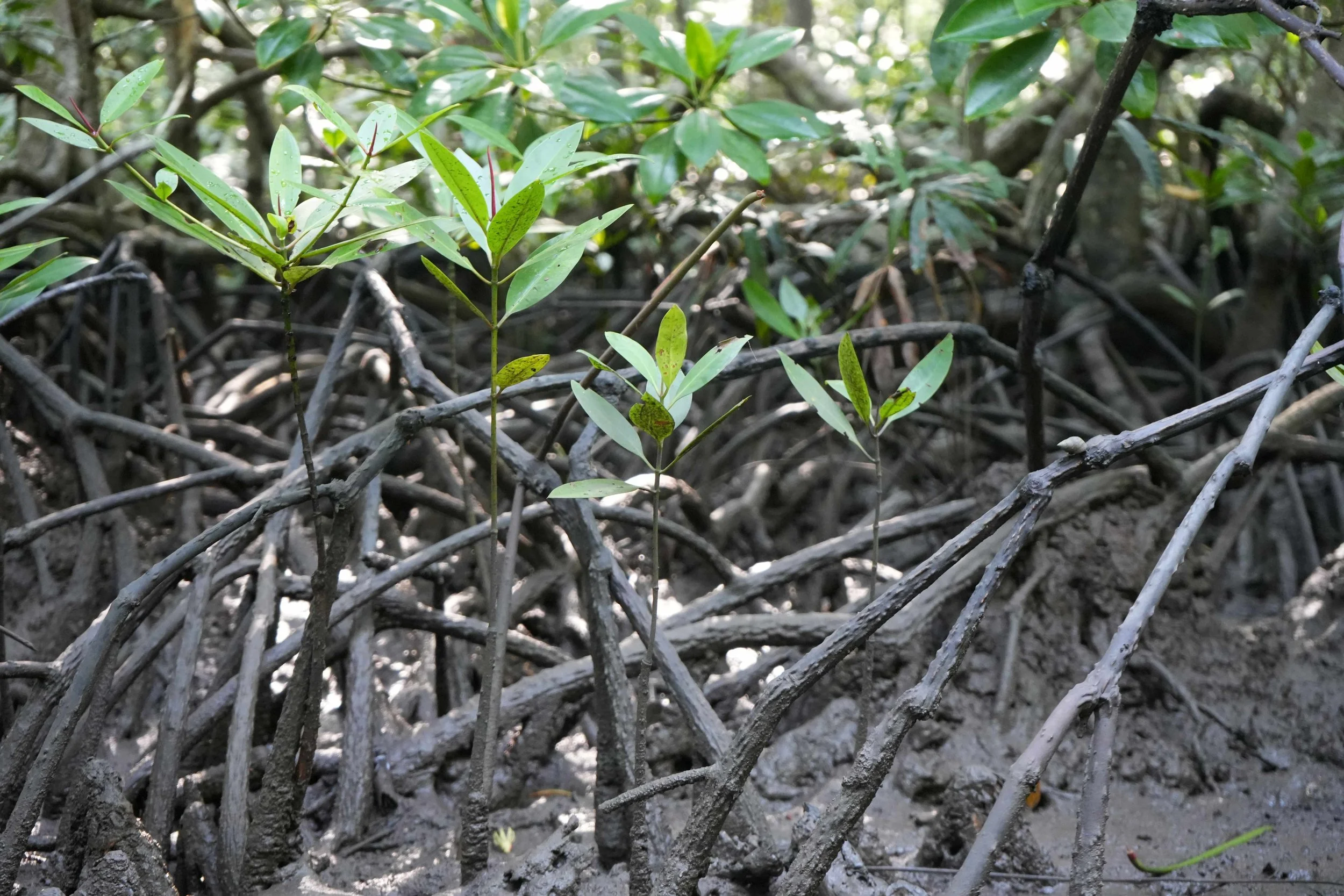
Indonesia in 2025 still saw 66% jump in deforestation nationally, affecting over 430,000 hectares. Approximately 20% of Indonesia's remaining mangroves are considered degraded. Destructive fishing practices continue to threaten the coral biodiversity that makes these waters globally significant. The conservation sector is making an impact, but it is not yet winning. We have mapped out over 26 million hectares of high-conservation forest in terrestrial ecosystems alone, and more than double that in coastal areas, where this community-led conservation model could work. That is not a sign that the work is nearly done. It is a sign of how much remains.
What I am resisting is the assumption that a “where we work map” with more national flags on it is a more serious map. It is not. A serious map shows where the behaviors you are trying to spread are taking root, in whose hands, with which institutions, under what rights, and how far those patterns are traveling without you.
A better question
Planet Indonesia is Indonesia‑led, calibrated to Indonesian regulatory frameworks, and already moving the model into the hands of Indonesian partner organizations that hold the legitimacy and relationships to grow it further.
So the question I return to peers and funders is not combative. It is just different.
If our collective efforts at Planet Indonesia could contribute even slightly to shifting the systems that protect Indonesia’s ecosystems, across this vital tropical basin and archipelagic nation where so many steward a biophysical heritage we all share, we wonder how that quiet, steady progress might align with your own hopes for change.
That is a question about influence, not optics. It is also the question, I think, that our sector has to learn to ask. The communities we work with are not waiting for us to complete our geographic expansion before deciding how to govern their forests and seas. They are doing it now. Our job, for the decades ahead, is to help those systems become durable enough to work without us—here, where the work already is.
A subcontinent, not a country program. Once you see that, the question about “more countries” starts to answer itself.
Sources and further reading
Brazil, Indonesia, Democratic Republic of Congo. Joint Statement on climate and forests, G20 Bali, November 2022. See coverage in Mongabay, CNN, and Time (Nov. 2022).
Warren, M. W., et al. (2017). “An appraisal of Indonesia’s immense peat carbon stock using national peatland maps.” Carbon Balance and Management / CIFOR-ICRAF.
WWF & Coral Triangle Initiative for Coral Reefs, Fisheries, and Food Security (CTI-CFF). Coral Triangle biodiversity statistics.
Natural Earth 1:110m cultural vectors; Indonesian Geospatial Agency (BIG) and comparative coastline figures via World Atlas.
Moore, M.‑L., Riddell, D., & Vocisano, D. (2015). “Scaling Out, Scaling Up, Scaling Deep: Advancing Systemic Social Innovation and the Learning Processes to Support It.” Journal of Corporate Citizenship 58.
Starr, K. Mulago Foundation. Public writing on scale and “it ain’t you.”
Miller, A. (2025). “It Ain’t You: Lessons on Scale, Control, and Clarity.” Planet Indonesia blog.
If you have any questions, please reach out via admin@planetindonesia.org. Sign up for our newsletter and follow us on our social media Facebook here, Instagram here, and LinkedIn here to get timely updates on our activities, an insider’s look into the lives of front-line conservationists, and ongoing programs.