
Keeping the River Clear: Meragun Adds Wildlife and Mining Rules to Its Customary Law
By Aurore Maxey and Muhammad Fauzi
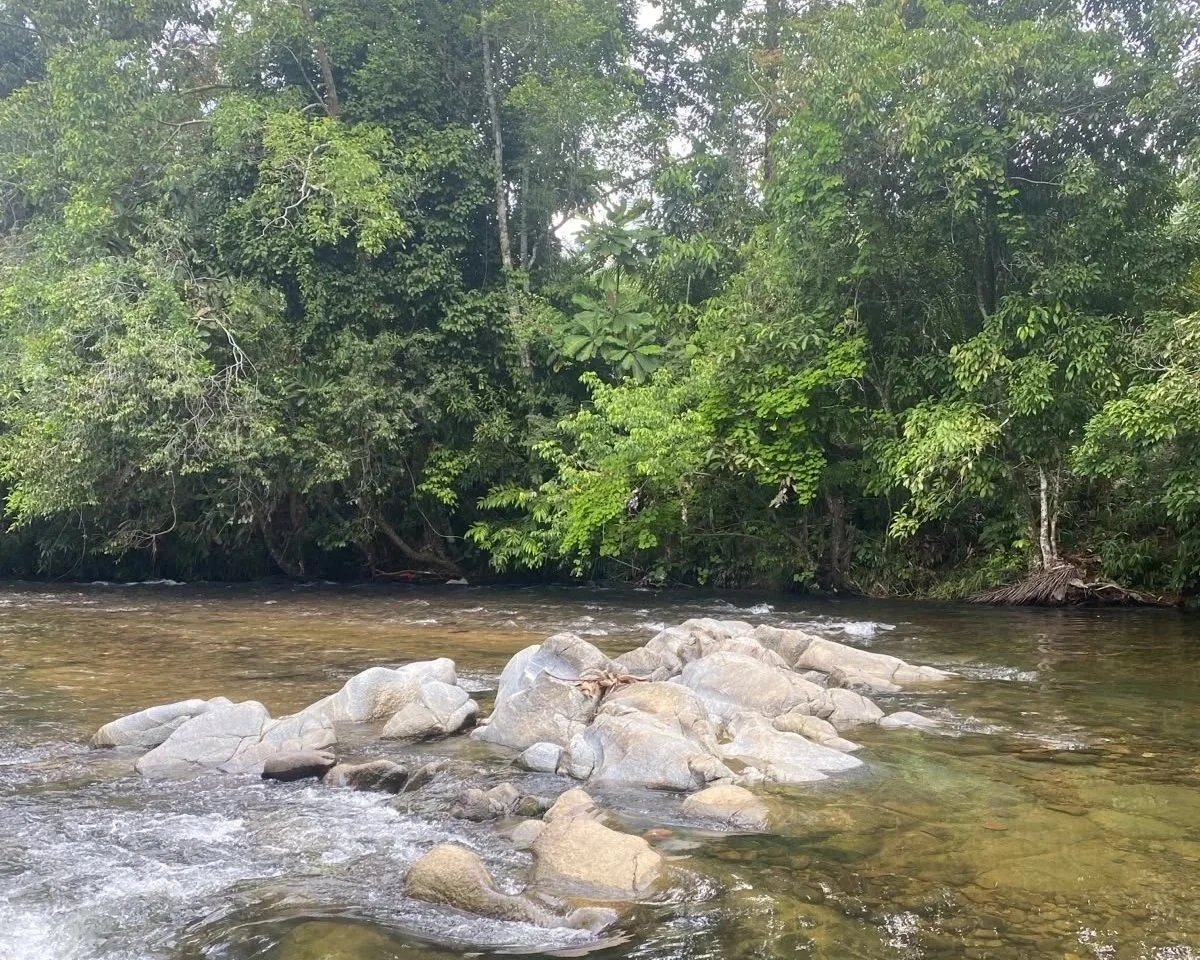
The Meragun River where it runs through the village centre.
In Meragun village, West Kalimantan, Indonesia, customary leader Pak Among says unlicensed gold mining is already polluting the river.
On 14 September 2026, 68 people gathered in Meragun, in Nanga Taman sub-district, Sekadau district, to ratify two new articles in the village's customary law book (Buku Hukum Adat). One protects wildlife and plants. The other bans unlicensed gold mining, known locally as PETI. Both are now formally part of Meragun's Buku Hukum Adat.
Adat, or customary law, is a system of customary rules Dayak communities use to govern community life and shared resources, upheld by their own customary institutions. Adding these two articles took almost a year; it started with a conversation about pangolins.
It started with a pangolin
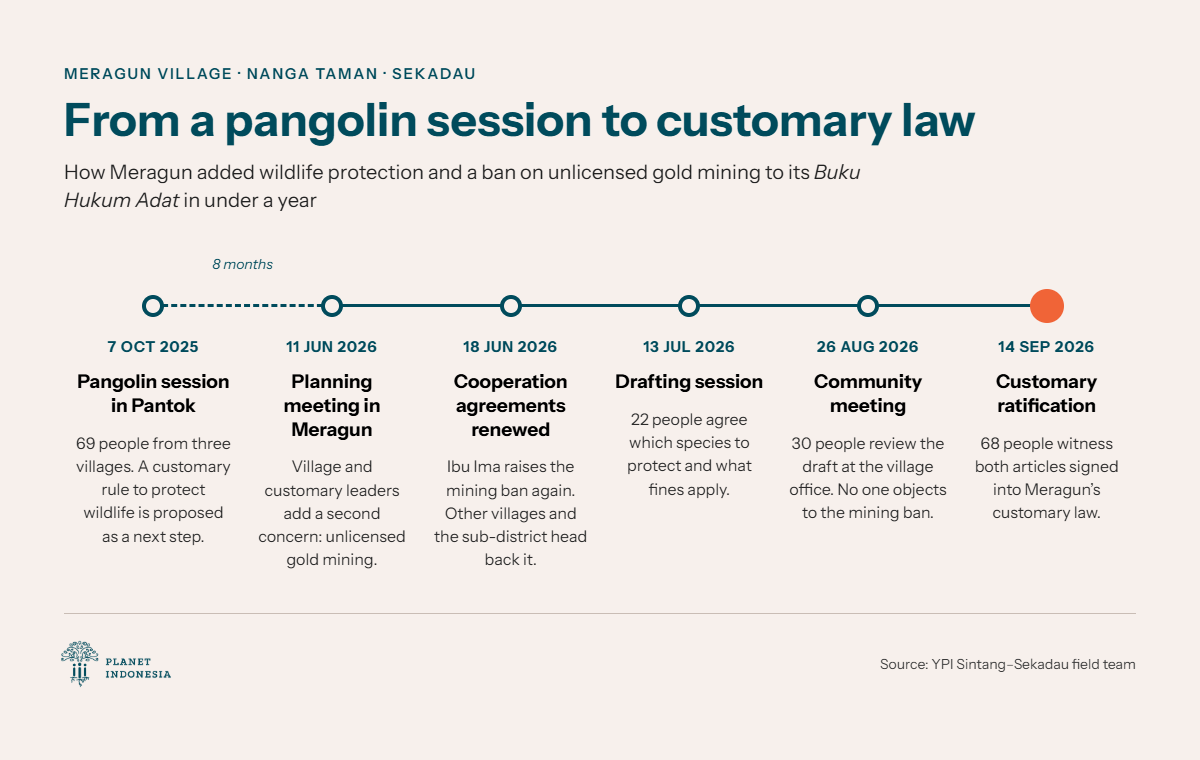
From a pangolin session to customary law: how Meragun’s two new articles came together.
In October 2025, Yayasan Planet Indonesia (YPI) held a session in nearby Pantok on the Sunda pangolin (Manis javanica), a critically endangered species. Sixty-nine people attended: residents and village governments from Pantok, Meragun, and Karang Betung; sub-district officials; BKSDA (the government’s regional conservation agency); and the Sekadau forest management unit (KPH Sekadau). Participants were especially drawn to a video about pangolins, and many women actively participated in the discussion.
By the end of the session, participants agreed on three next steps for their villages: school visits, signs in each settlement showing which species are protected, and a customary rule to protect wildlife, an idea YPI’s team proposed and the village heads of Meragun and Pantok adopted.
Eight people met in Meragun in June 2026 to plan how they would draft that rule. But wildlife was not the only concern on the table. Meragun’s village head, Ibu Ima Kulata, and customary leader Pak Among also spoke about unlicensed gold mining and its impact on the village's water.
Unlicensed gold mining has long plagued West Kalimantan’s rivers. When rivers turn cloudy, it’s often one of the first signs of mining activity. But the bigger concern is what may be entering the water. Many small-scale gold miners use mercury to extract gold, and artisanal and small-scale gold mining is the world’s largest source of human-made mercury emissions. Mercury builds up in water and fish, and exposure can damage the nervous system, kidneys, and other organs.
Mining first appeared in one part of the village in mid-2025. The Meragun and Mentrap rivers ran cloudy, and the village government went with local authorities to warn the miners. Since then, the village has watched the Meragun River where it passes through the village centre; if it runs thick and muddy when there has been no rain, the village government and authorities go to the site, and customary leaders take the lead from there. Village leaders wanted a rule in place before mining spread further. Petrus Onem, head of the sub-district's Indigenous Dayak Taman customary council (Dewan Adat Dayak, or DAD), supported the idea. “It’s easier to prevent PETI before it becomes widespread in a village,” he said. Of the 15 villages in Nanga Taman, he added, only three, Meragun, Pantok, and Lubuk Tajau, still have clear rivers.
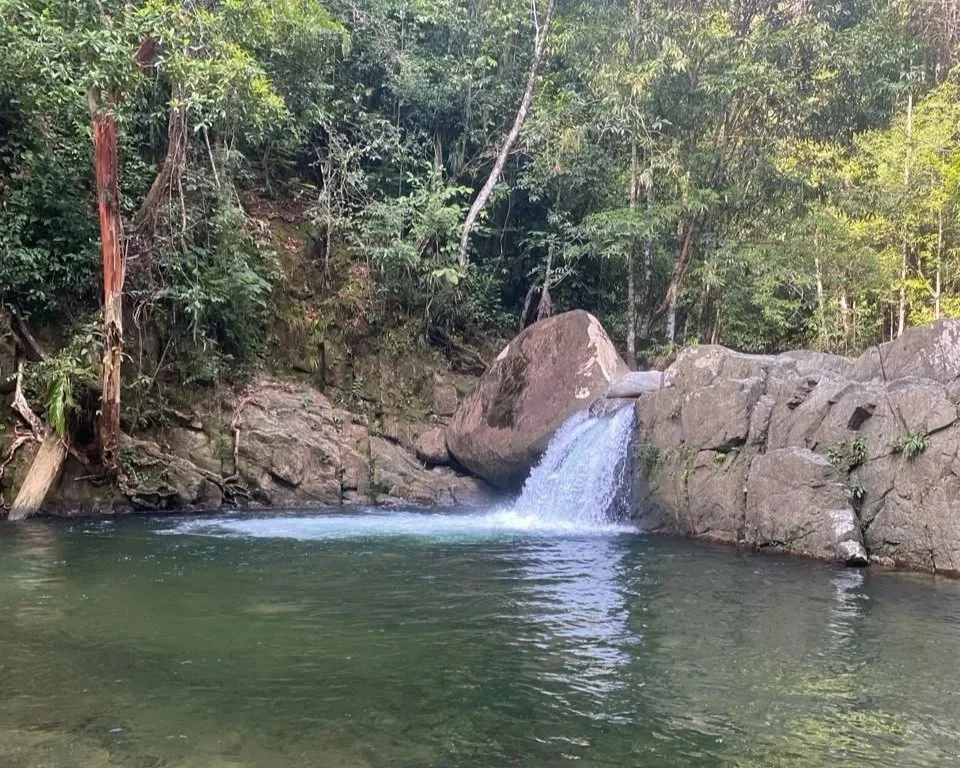
The Meragun River in the village centre, where the village watches for signs of mining upstream.
A week later, when YPI and the four partner villages met to renew their cooperation agreement, Ibu Ima raised the issue again. The village ultimately decided to work on two articles: one on wildlife and plants, and one banning PETI. The wildlife article grew out of the pangolin session. The village government and customary leaders themselves introduced the mining ban.
Writing the rules
In July, YPI’s Sintang-Sekadau regional manager Muhammad Fauzi and Meragun field facilitator, Yoga Kasbara, led the main drafting session, which brought together 22 people (17 men, 5 women): customary leaders, village government representatives, the sub-district DAD, and community members. The discussion was long and at times difficult. Participants disagreed over which plants and animals the rules should cover, and over how large the fines should be: some wanted heavier penalties, others lighter ones. But everyone in the room supported the aim, and by the end they had settled on both the list and the fines now written into the articles. Meragun’s customary institution enforces them. The wildlife article names ten protected animals, including the orangutan, pangolin, rhinoceros hornbill, helmeted hornbill, Bornean white-bearded gibbon, and sun bear. A second category covers hardwoods, including the ironwood known locally as ulin: Meragun residents may cut them for their own use but not sell them. People from outside the village may not take gaharu, agarwood, a resinous heartwood that fetches high prices in international markets, from Meragun’s forest.
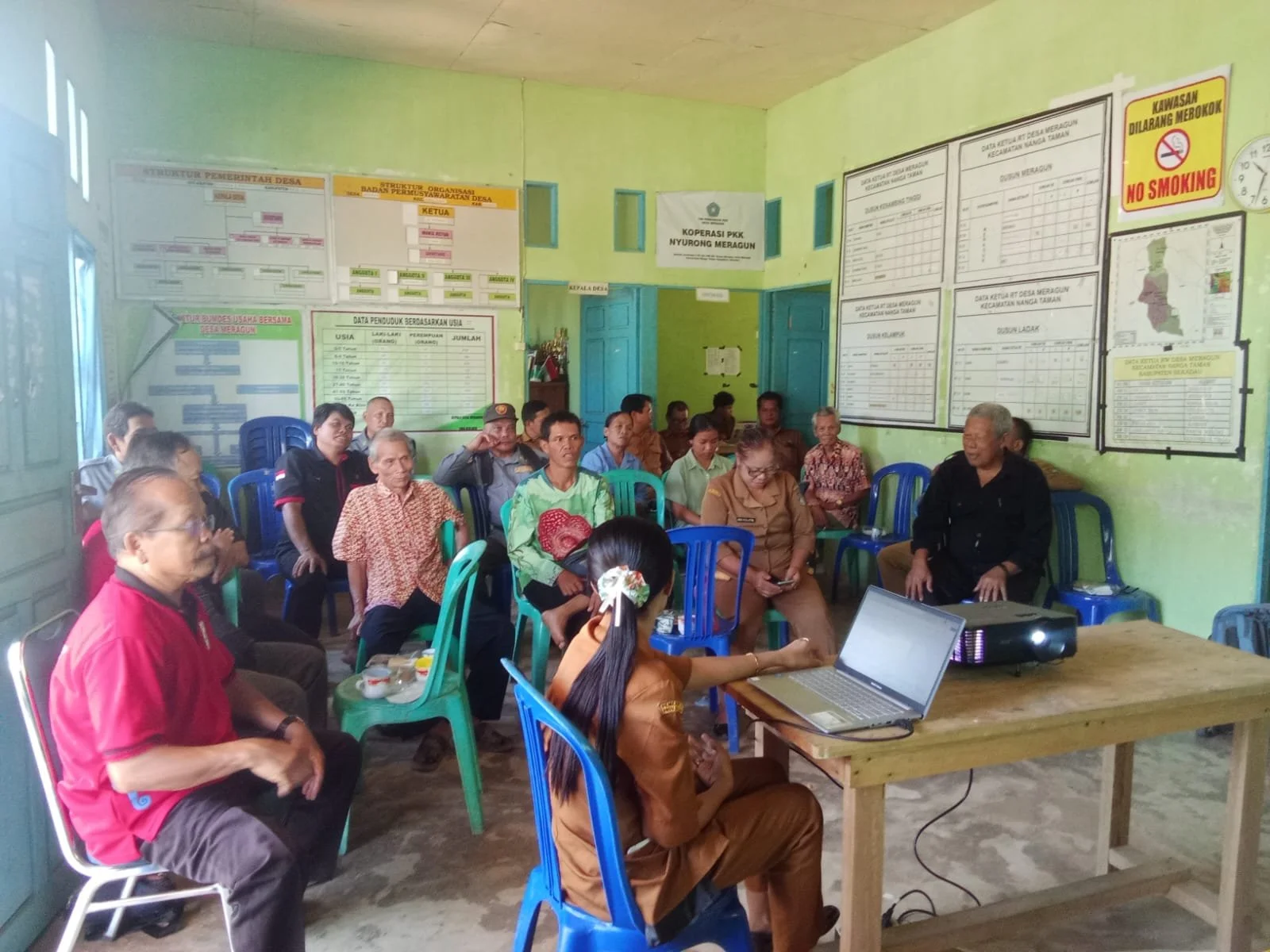
Customary leaders, village government and community members draft the new articles in Meragun.
Customary sanction works differently from a court fine. Alongside any cash penalty, the person at fault provides goods for a communal gathering: a pig of at least fifty kilos, village chickens, rice and eggs, handed over in front of the community rather than paid to an authority. Killing a protected animal carries that consequence. Selling protected hardwood, or taking gaharu as an outsider, carries the same penalty plus five million rupiah (around US$300) and confiscation of what was taken. Mining carries the heaviest penalty in both forms: a larger customary payment of ten million rupiah (around US$600), and seizure of equipment.
In late August, when the draft articles were presented to the wider community, the meeting was held at the village office rather than across all four hamlets as originally planned, as families were preparing for nugal, the season's rice planting. One question prompted debate: could hardwood trees still be cut to build homes? Pak Among explained the article in more detail until everyone present understood it. A few weeks later, the village was ready to ratify the two articles.
Why now
Until this year, Meragun’s Buku Hukum Adat said nothing about wildlife or forests. For generations, people had relied on the forest for hunting and gathering food. Animals were abundant, and there was little reason to think they needed protection. But things are different now. Some animals that hold special meaning in Dayak Taman tradition are becoming harder to find. One of them is the burung labe, Asian paradise flycatcher. Traditionally, seeing one fly across your path is a warning: you should turn back or wait an hour before continuing your journey. You can still find the bird around Meragun, but sightings have become less common. Other birds bring good news. Hearing the call of burung ketipung, a woodpecker species, while out hunting or fishing means a good catch is coming. The ketipung isn’t on the new protected list: it is still common and isn’t hunted.
The river is another concern, as many families still rely on it for bathing and washing. Ibu Tasiana, a Meragun resident, is one of them. She supports the mining ban so the water stays clear for washing, and so children can still catch fish there. Ibu Cika, a younger resident, backs both articles for similar reasons: to keep wildlife from disappearing, protect the forest, and keep the river clean for the many families who depend on it. Village leaders are determined to keep it that way. According to them, Meragun's river is one of only two major rivers in the sub-district that still run clear. The other is the Ntukak River, which flows through Pantok and Lubuk Tajau. The forest also provides water beyond Meragun. Village leaders say water from the area supplies Nanga Taman, the sub-district centre, as well as parts of the neighbouring sub-districts of Sekadau Hulu and Sekadau Hilir, including Sekadau town.
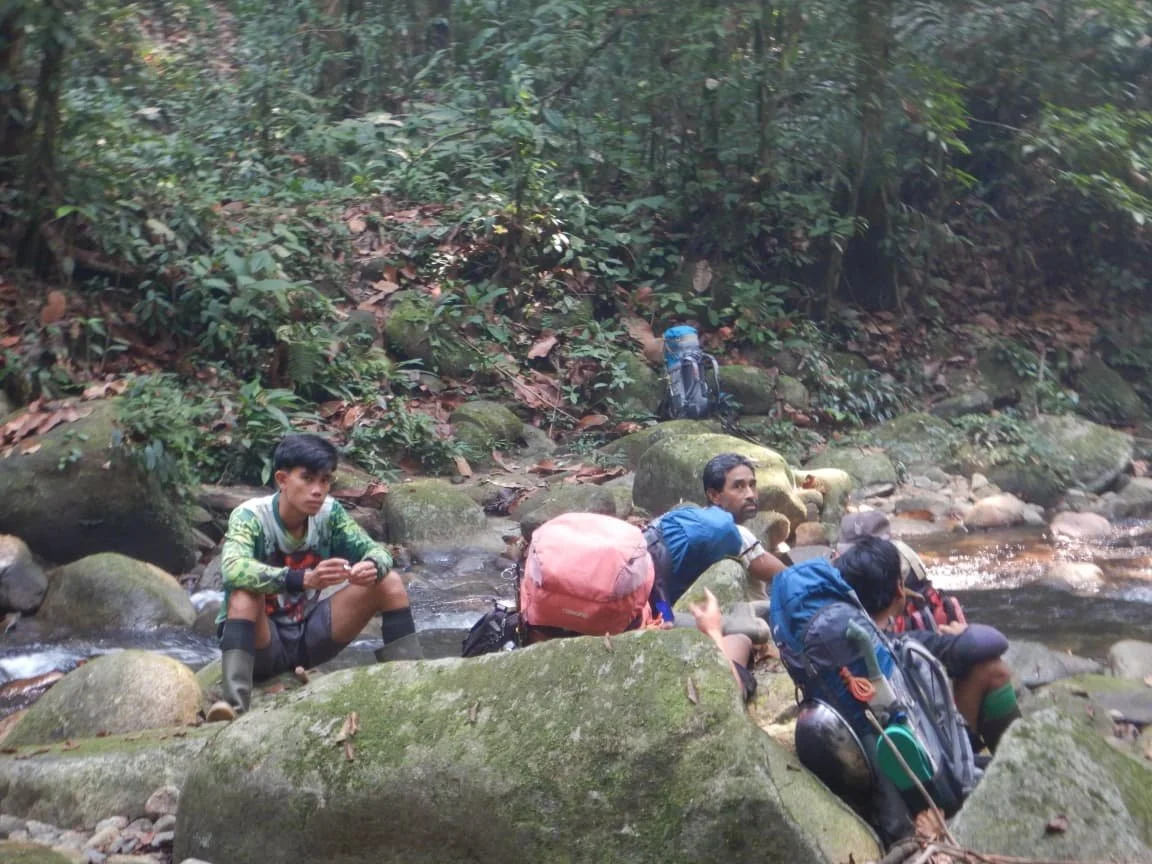
Members of PUMK Mentrap Pugan and the SMART patrol team.
The decision to ban unlicensed gold mining had economic consequences, but village leaders believed the benefits of protecting the river outweighed them. They estimated that the ban would affect fewer than ten of Meragun's 2,822 residents financially. For them, protecting the wider community's health and safety mattered more.
Protecting pangolins raised a different challenge. People had poached them in Meragun, and their scales could be sold for between Rp500,000 and Rp700,000 per kilo. But attitudes are beginning to change. Some residents now talk about wanting their grandchildren to see these animals in the wild. Others are more cautious because of the penalties under customary and national law.
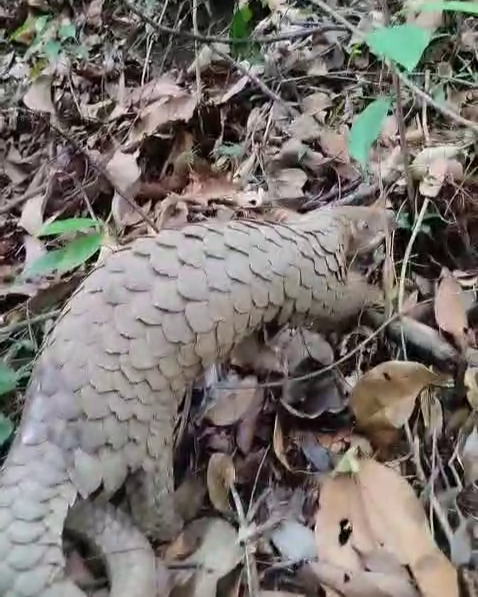
the release of a pangolin into the forest after a farmer handed it over.
One example came in early October 2026, when Pak Lawai, a farmer in Ladak hamlet, found a pangolin in his field. Instead of selling it, he handed it over to PUMK Mentrap Pugan, the local forest management group. Together with members of the village's SMART patrol team, including both men and women, the group released the pangolin back into the forest, away from houses and farmland. These changes did not happen overnight. Before the new articles were drafted, Meragun's village head, Ibu Ima Kulata, had already responded to reports of mining by bringing authorities and community representatives to inspect the sites. She had also requested support for the formal recognition of Meragun as a customary-law community and its customary forest.
Customary leaders, who had seen wildlife become less common over the years, supported the new rules. The DAD Nanga Taman also backed the initiative and hopes similar protections can eventually be adopted across Nanga Taman. Meanwhile, the work of PUMK Mentrap Pugan and YPI, through SMART patrols, wildlife monitoring and school visits, had already been helping residents learn more about the forest and the animals living in it. The new customary rules build on that work, giving the community a way to protect what it wants to preserve for future generations.
The day the rules became law
At the ceremony, a Berita Acara (official record) was signed. The village government, the village council (BPD), customary leaders, and representatives of all four hamlets agreed to it, and the sub-district DAD, Ayonk Taman, and local military and police representatives witnessed it.
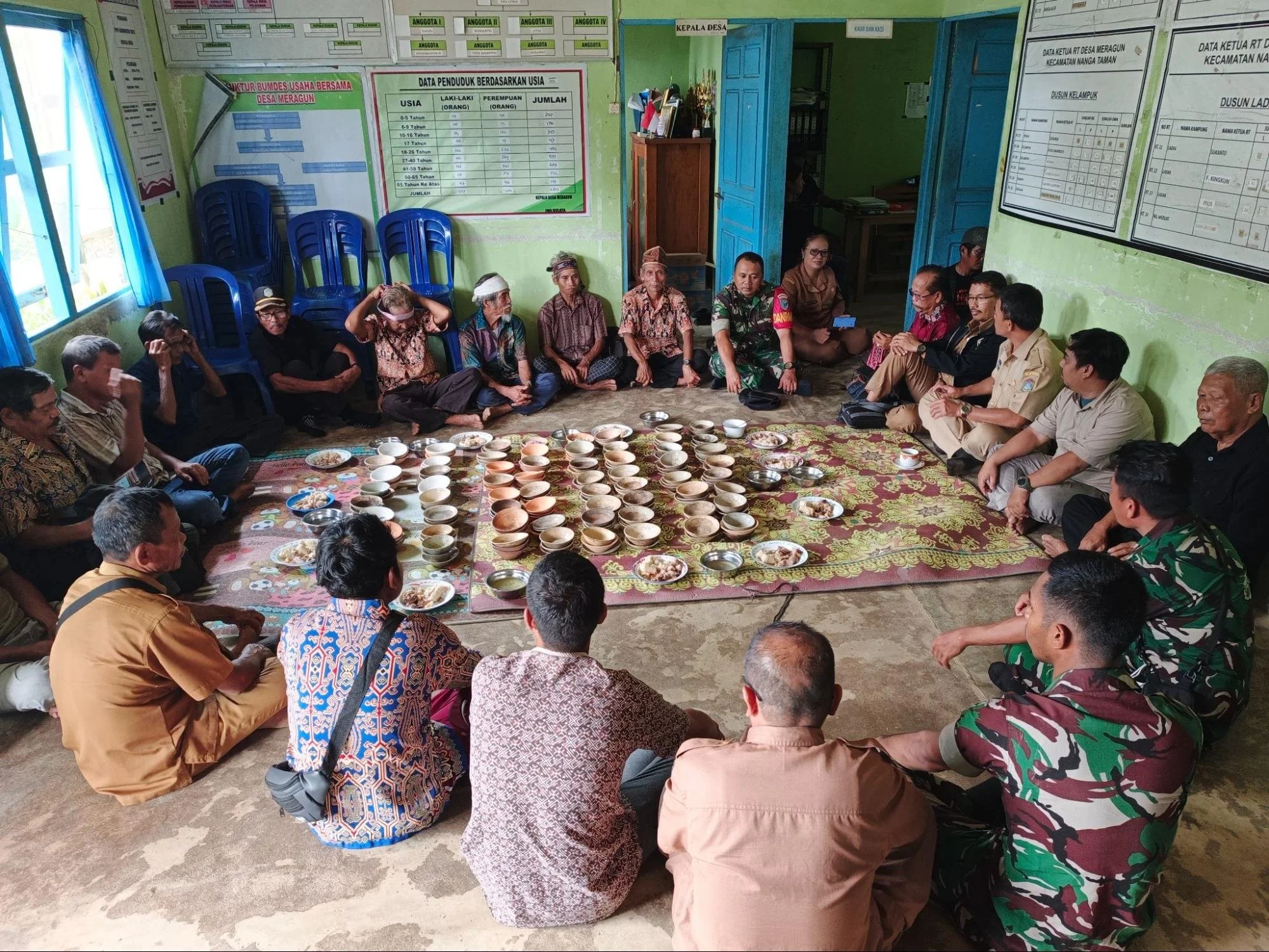
The customary ceremony ratifying Meragun’s two new articles.
Pak Among spoke about why some of the species covered by the new rule mattered locally:
"Certain animals that, in our tradition, are signs of good or bad fortune are now rarely seen at all. As for the mining ban, it's urgent, because it's already starting to pollute our river."
Pak Among spoke about why some of the species covered by the new rule mattered locally:
“Certain animals that, in our tradition, are signs of good or bad fortune are now rarely seen at all. As for the mining ban, it’s urgent, because it’s already starting to pollute our river.”
Petrus Onem spoke about the four meetings that had led to the ratification:
“This was our fourth meeting on this. We’re grateful to Yayasan Planet Indonesia for facilitating and supporting us from the beginning through this ratification. The DAD fully supports this, and we’re ready to stand behind it if a case ever comes up, because this article matters for the future of our forest.”
Gunawan, head of Ayonk Taman, the Dayak Taman customary institution for Sekadau district, spoke about what comes next:
“What we’ve agreed to has to be carried out wholeheartedly and honestly. We’re ready to help if needed. Going forward, we at Ayonk Taman also plan to write rules on flora and fauna into our own organization’s bylaws.”
For Ibu Ima Kulata, the rules are also about what future generations in Meragun will inherit:
“This rule exists as a form of protection, so that protected plants and animals aren’t hunted to the point our grandchildren never get to see them or benefit from them, and so there’s no more unlicensed gold mining in Meragun village.”
Beyond Meragun
Meragun may not be the only village to adopt such rules. Petrus Onem has brought the idea to his own village, Lubuk Tajau. Pantok village has also asked to develop its own version as part of its cooperation agreement renewal with YPI. Pantok's village head has suggested taking it further, with similar rules eventually adopted across the sub-district. Onem had first raised the idea of a sub-district rule himself. However, a sub-district rule would take longer to develop, and Meragun's leaders felt they could not wait. So they moved ahead at village level first.
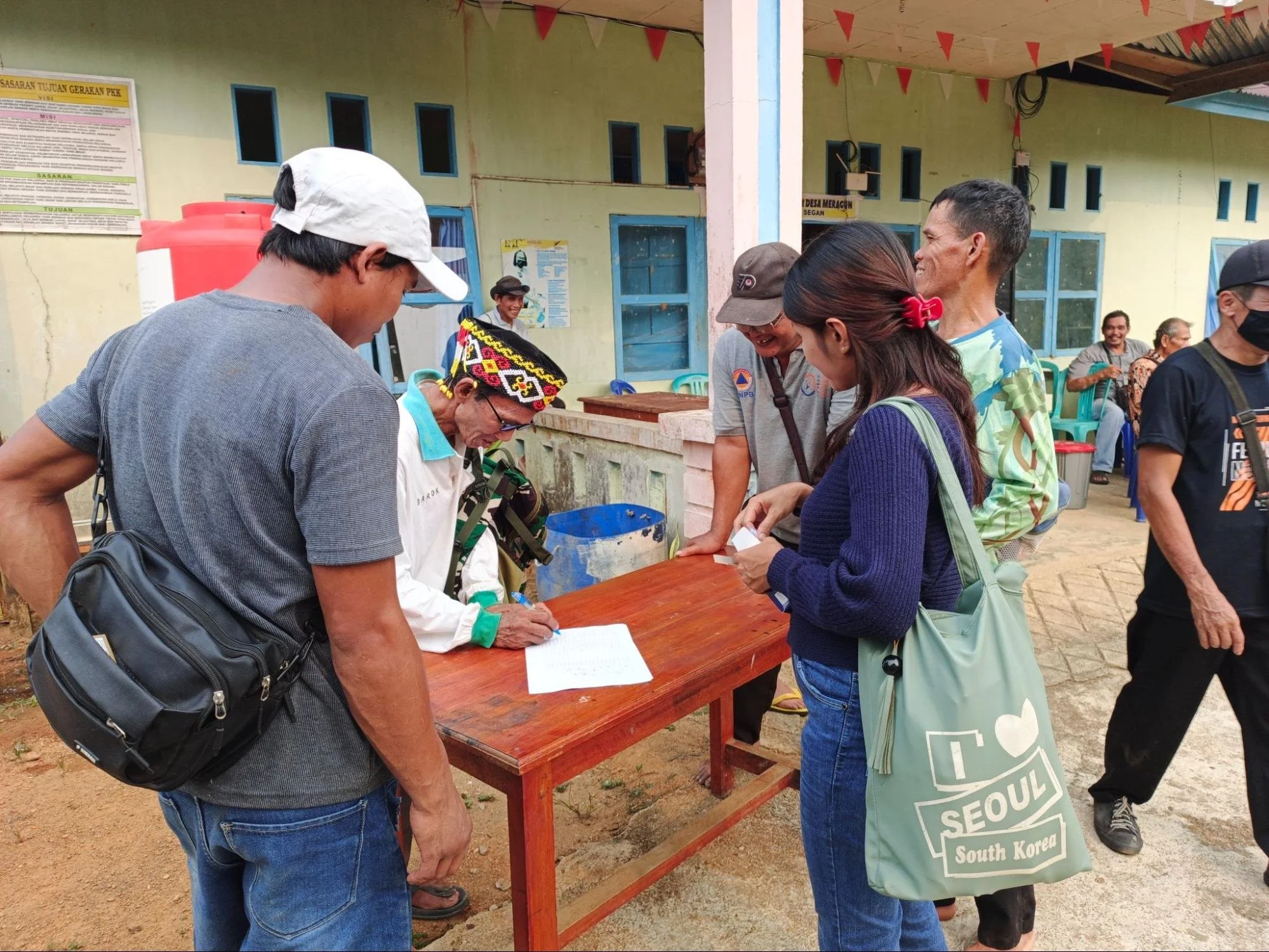
Participants register for the ratification ceremony.
In Meragun, the work is now turning to implementation. The village is preparing signs listing protected species and the mining ban for its four hamlets. The Buku Hukum Adat has also been revised. The two new articles were added without changing any of the customary rules already in the book. Existing articles remain protected: changing one would itself carry a customary fine. Customary leaders and the village government, down to hamlet and neighbourhood heads, share the job of watching for violations. Local police and military, who have traced the source each time the river has turned cloudy, attended the ratification and back the rule.
What began as a conversation about pangolins is now part of the law Meragun has written for itself, protecting its wildlife and its river.
If you have any questions, please reach out via admin@planetindonesia.org. Sign up for our newsletter and follow us on our social media Facebook here, Instagram here, and LinkedIn here to get timely updates on our activities, an insider’s look into the lives of front-line conservationists, and ongoing programs.