
Advancing Customary Tenurial Rights in Area-based Conservation: An International Forum of Scholars and Practitioners
By Paul Thung
Last year, Planet Indonesia helped organise a Forum in Meanjin/Brisbane, Australia, prior to the International Congress on Conservation Biology (ICCB). At the two-day Forum, 22 scholars and practitioners from around the world exchanged insights and experiences on the important topic of “Advancing Customary Tenurial Rights in Area-based Conservation”. This blogpost outlines some background and highlights from our discussion. Please see our interim report for more details about our on-going process of comparison and analysis.
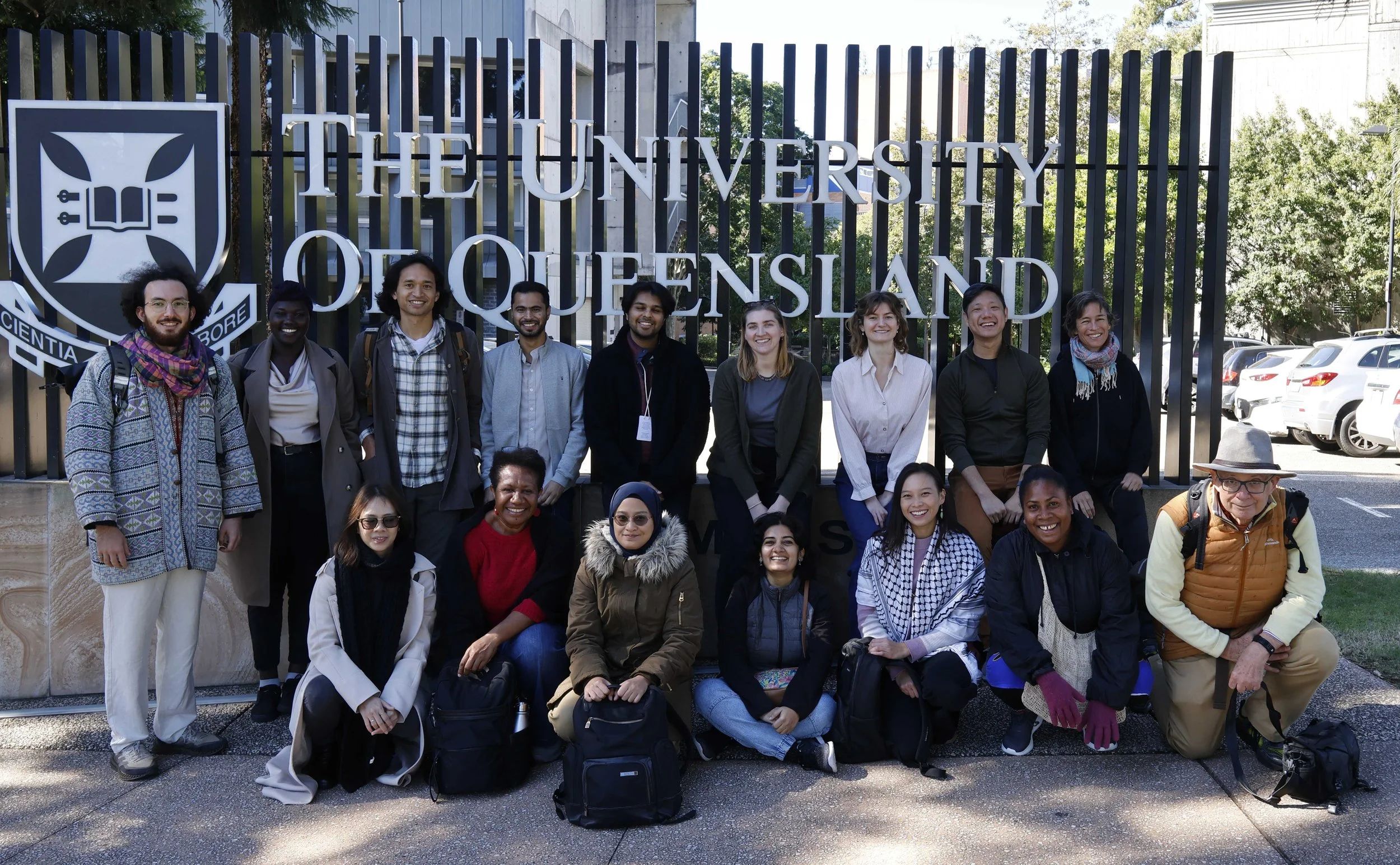
The majority of Forum participants during a lunchbreak on day 2 of the Forum on Advancing Customary Tenurial Rights in Area-based Conservation, held in Meanjin/Brisbane ahead of ICCB.
Opportunities and barriers to bridging the tenure gap
We were brought together by a shared concern over the lack of tenure security faced by many people living in high-biodiversity areas. Indigenous Peoples, local communities, and Afro-descendants claim customary rights over large parts of the world’s lands and seas, based on traditional norms and histories of stewardship. However, in many cases, these claims are not formally recognised or protected. This tenure gap has both practical and moral implications, and is now widely recognised as one of the key barriers to equitable, community-led conservation. In response, activists, policymakers, researchers, and practitioners are increasingly advocating, and directly facilitating, stronger recognition of communities’ rights and access to territory.
Naturally, this shared agenda takes place in a multitude of different contexts. Communities across the world have varying aspirations, opportunities, and challenges. It can be challenging for international discourse to keep track of all this complexity and diversity. However, doing so is essential to avoid misrepresentations and unintended effects. In Indonesia, for example, existing policies for formalising community access to forests often do not accommodate communities’ own practices, visions, and priorities. The pathways to recognition are limited, bureaucratic, and based on external concepts of territory and indigeneity. These policies are certainly better than nothing, but implementation requires an awareness of their limitations and ramifications. Without such contextual awareness, there is a risk that ambitious global agendas will push for scaling up narrow legal pathways, which may not solve but “further obscure” ongoing tenure insecurities.
ICCB 2025, one of the largest international meetings of conservation scientists and practitioners, provided an opportunity to compare pathways, barriers, and enabling factors across different contexts. Through this Forum, we aimed to enable learning between the participants; to develop a new, comparative perspective on how area-based conservation efforts are protecting customary tenure; and ultimately to formulate guidance for improving such efforts going forward.
Lessons from the Forum
The discussions at the Forum were wide-ranging, covering global, regional, and local scales, and a range of countries including India, Indonesia, Australia, Papua New Guinea, Kenya, and Fiji. It was clear that efforts to advance customary tenure rights look different everywhere, but we also found striking parallels. Four key themes stood out:
Even where national policies for recognising customary tenure exist, there is often a lack of political will and bureaucratic capacity for properly implementing them. Indigenous Peoples, local communities, and their allies therefore have to draw on a diverse portfolio of laws, mechanisms, tools, and technologies: advocating and applying for formal recognition at multiple scales, while simultaneously strengthening local capacity and control over natural resources in practice.
In many cases, international partnerships play an important role in advancing these efforts, helping to mobilise political, technical, and financial resources. However, international partnerships also carry risks, as different priorities and understandings can create tensions, for example, when international partners claim successes without properly acknowledging the contributions of local allies.
Legal frameworks and social realities are significantly shaped by colonial and postcolonial histories, which have unfolded differently across countries. What tenure security means for different communities reflects their specific histories, aspirations, and identities. In settler colonial contexts like Australia, where there is continued occupation of Indigenous lands, for example, struggles for tenurial rights look very different than those in Papua New Guinea, where over 97% of land is under customary title.
New forms of technology and data are transforming efforts at advancing customary tenure, opening new possibilities for advocacy and monitoring, while also raising new concerns about control and representation. The rapidly expanding technological capabilities of satellite imagery, for example, can intensify surveillance and further erode local control over environmental research. But the same technologies can also be harnessed to strengthen local control over forests, for example, through community-led monitoring of forest encroachment.
To carry these lessons forward, we have set up a steering committee that will facilitate ongoing collaboration between the Forum participants. We are currently working on a comparative analysis of how the development of new conservation targets and tools related to tenurial rights plays out in different settings. We look forward to sharing updates as that work progresses.
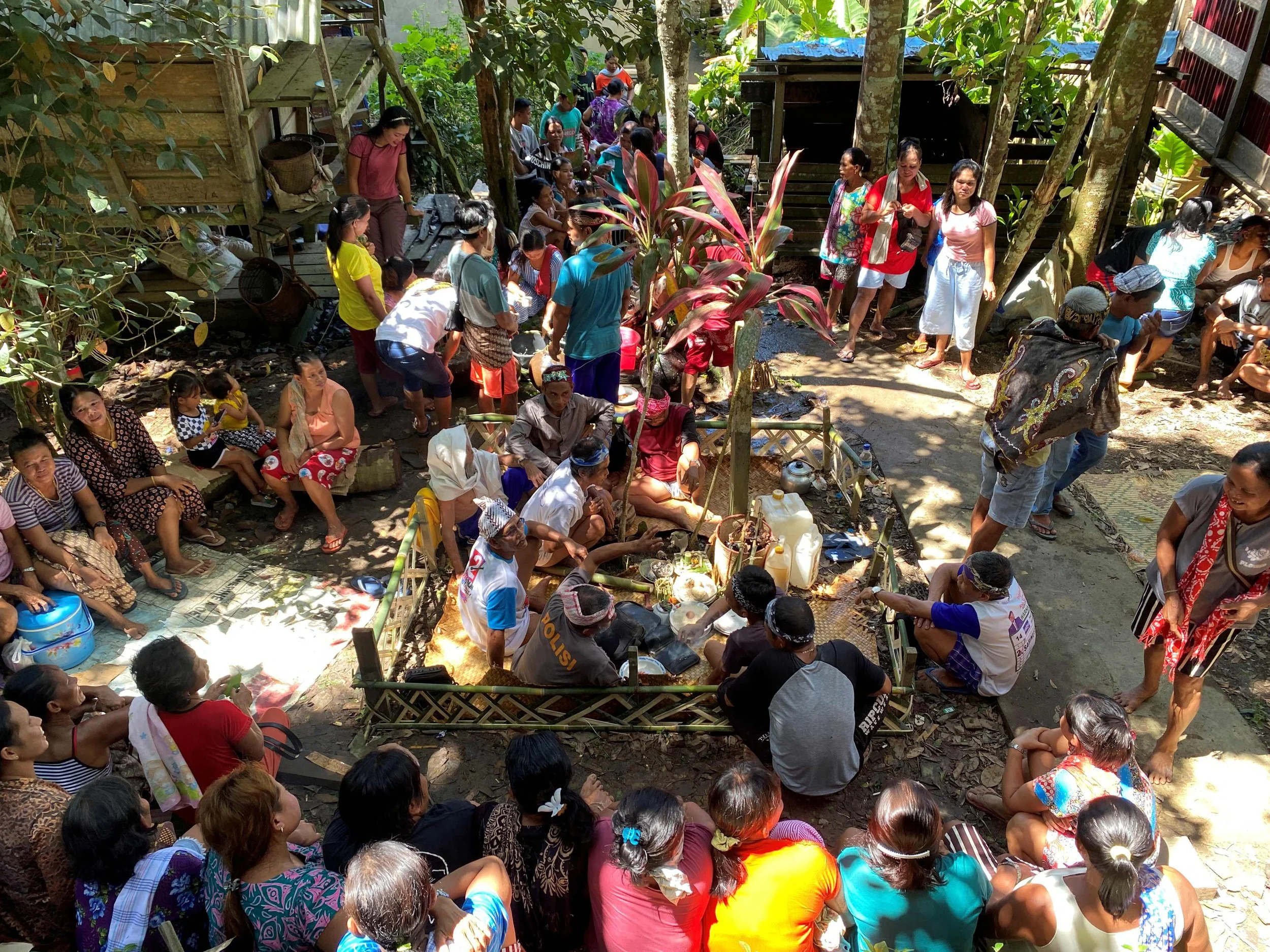
The red cordyline tree at the centre of this ceremony is believed to have the power to make the village of Buluh Merindu (in Indonesian Borneo) invisible to malevolent outsiders, thus symbolising local control over customary territory.
The event was co-organised by Greg Acciaioli (University of Western Australia), Shruti Mokashi (Ashoka Trust For Research In Ecology And The Environment), Devashish Saurav (Michigan State University), and Paul Thung (Planet Indonesia). While it was encouraging to find that there is widespread interest in these conversations, we were also reminded that access to scientific conferences remains highly uneven. For many who wanted to take part, traveling to Australia was not practical or realistic. Thankfully, Planet Indonesia was able to provide travel grants that helped broaden participation and the ICCB team was forthcoming in providing a venue and logistical support at no extra cost.
If you have any questions please reach out via admin@planetindonesia.org. Sign up for our newsletter and follow us on our social media Facebook here, Instagram here, and LinkedIn here to get timely updates on our activities, an insider’s look into the lives of front-line conservationists, and ongoing programs.